Drawing is Seeing
The pilot mannequin at the HAL Aerospace museum has always felt tragic to me. Staring straight ahead, arms hanging limp, strapped to an ejection seat. Every time I see him, I want to draw him. I feel like I owe him my attention.
We had a jam there a couple of weeks ago. As I drew his helmet, I became aware of a little handle just above his head. I didn’t think it was just decorative detail, so I looked it up. It is called a “face curtain.” Pulling it does two things—well, three, actually. It fires the ejection seat, clears the fighter jet’s canopy, and draws out a canvas panel that drapes over the pilot’s face, briefly shielding it from the blast of wind that I imagine roars into the cockpit once the canopy has peeled away. The handle attached to the seat between his legs is the secondary ejection mechanism.
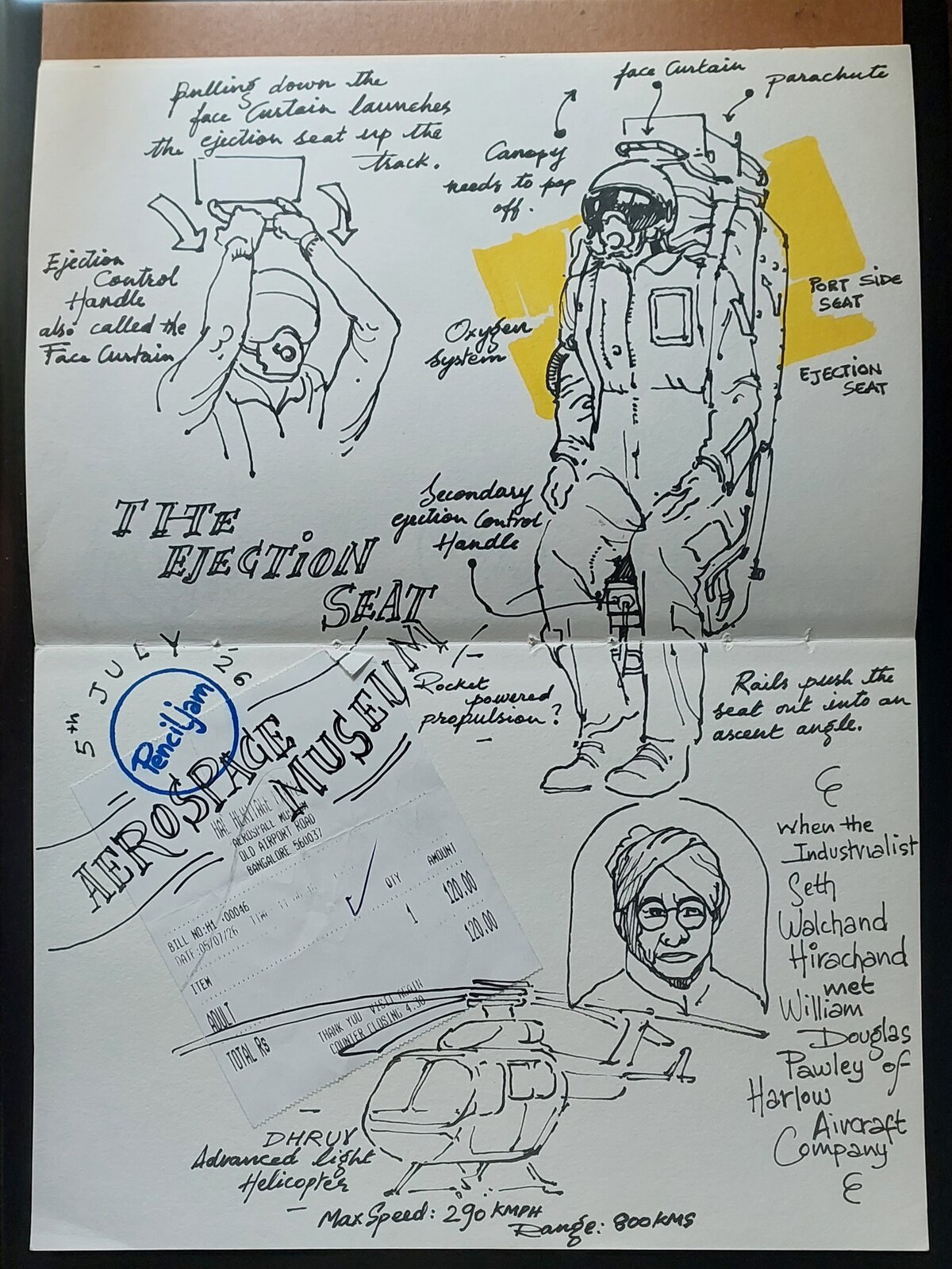
I know nothing about aircraft or ejection mechanisms The only reason I noticed those little details was because I was drawing them. Which brings us to the point of this post–drawing as a way of seeing.
For those who use drawing as a way to observe and record the world, and their experiences in it, (the same way most people use writing or numbers) it helps to think about the shape of our thoughts while we draw. This process is referred to as metacognition–to think about one’s thinking.
Drawing is obviously a thinking aid, if not a way of thinking in its own right. Drawing makes my thoughts visible, and makes me see things I may have missed when merely looking and so in this way, drawing also becomes a way of seeing.
Looking is a more involved process than seeing. To look at something means to consciously direct your attention at it. I narrow my cone of attention. I’m being specific. I’m labelling1. I’m completing an objective. It’s a top-down visual process.
Seeing on the other hand, is automatic2. It seems to occur, independent of me. It is a reaction to stimuli, a bottom-up process. It seems to happen instantaneously. A flash of yellow-orange-black in a sea of green stalks? Before I can even form a thought, my brain has already decided it is probably a tiger. It is safer to assume it is a tiger, it thinks, and not a newspaper fluttering past, with a full page Zomato ad on it, because Zomato ads won’t eat your face.
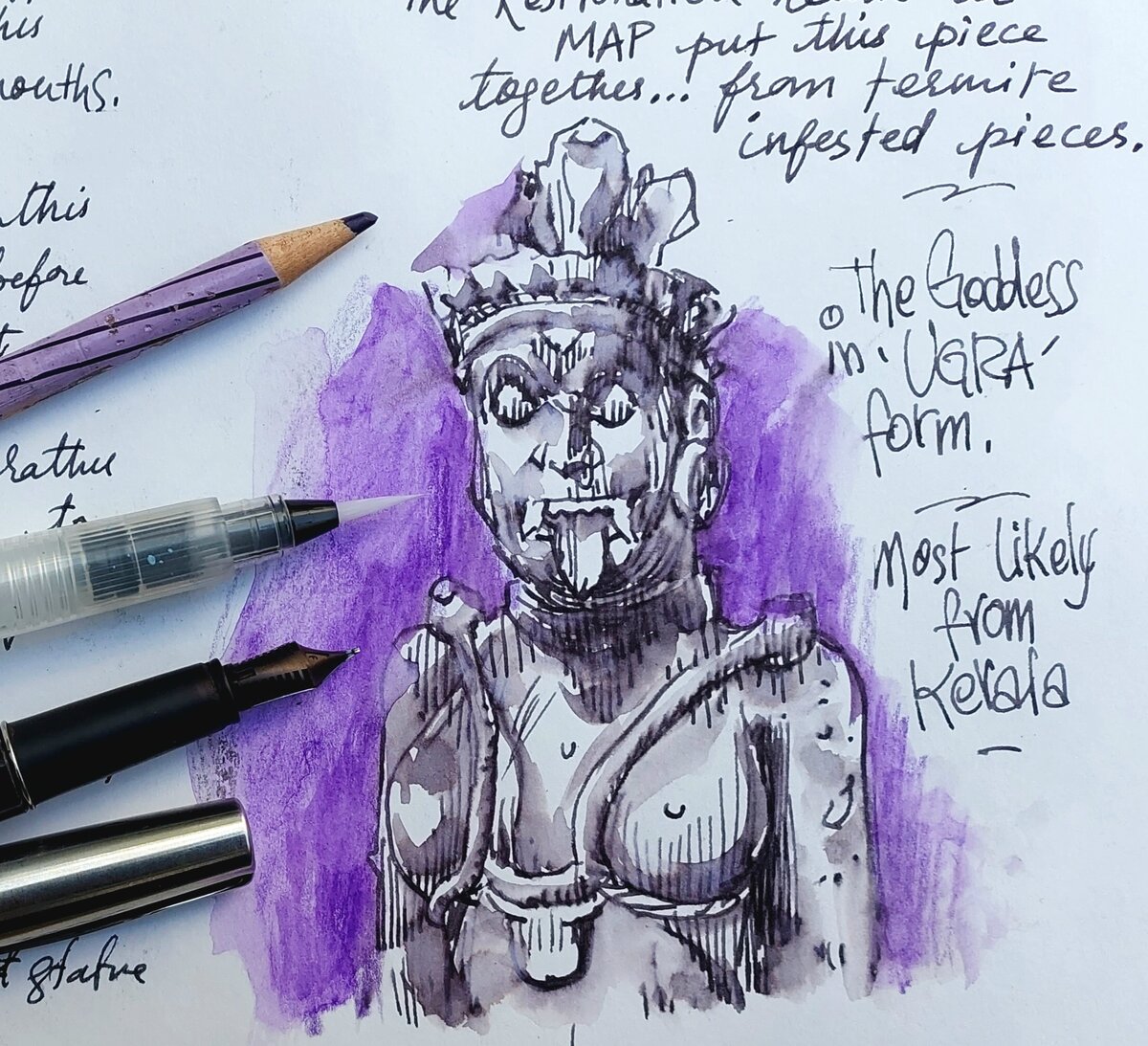
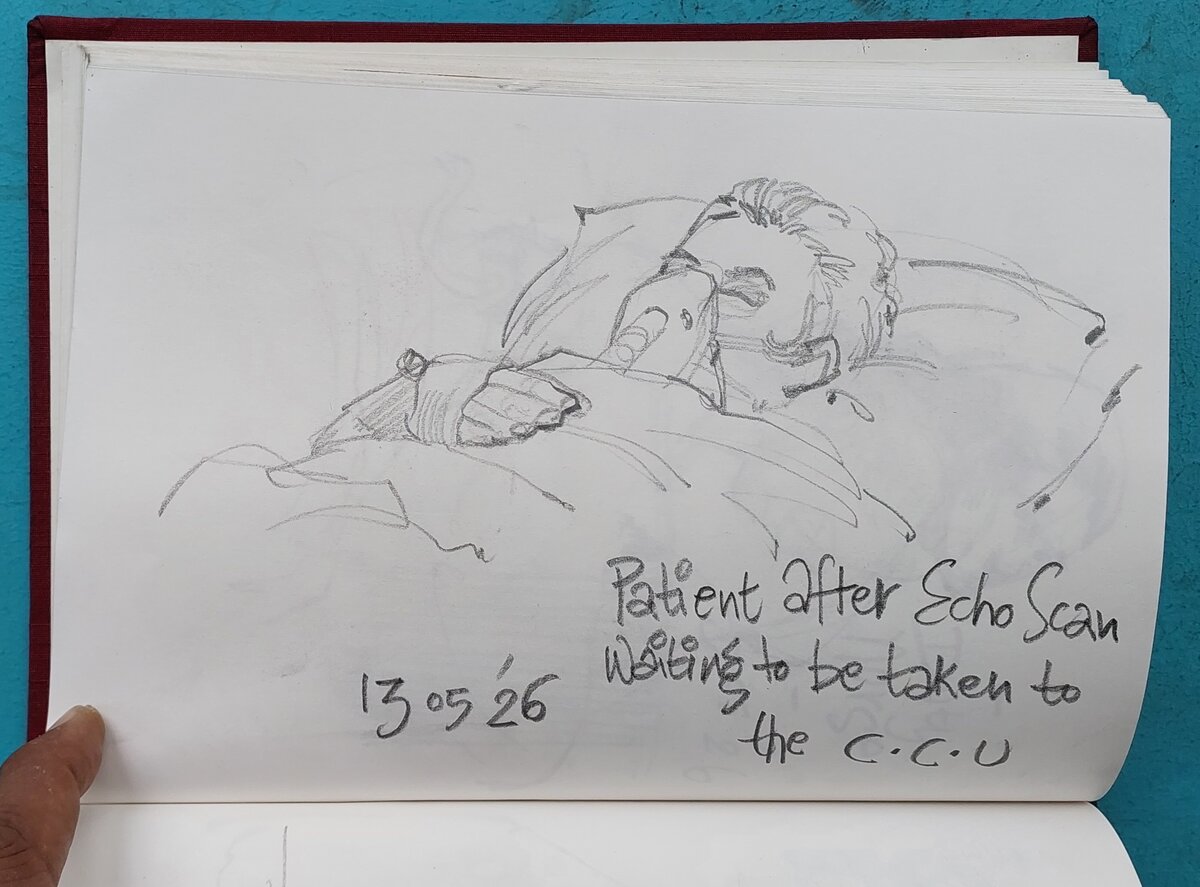
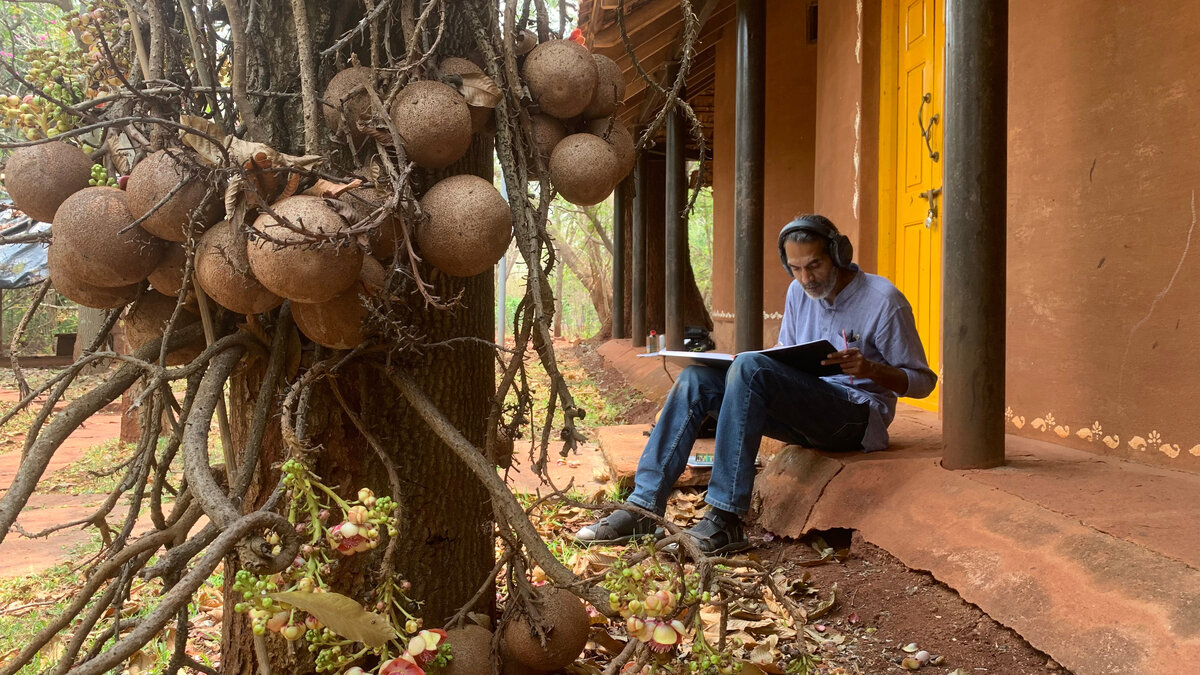
I find it helpful to be aware of my thought process when I draw. I’ve added some pictures from my sketch journals, with notes that try to explain what was going on in my head when I drew them.

Fine detail - Tipu’s Summer Palace
Tipu’s summer palace was begun by Hyder Ali, and completed by his son Tipu in 1791. It is beautiful structure lined with teak, walls painted with beautiful floral motifs, and as palaces go, it is a cozy little thing.
We jammed at the palace last year. As we were entering the gates, I overheard a couple. One of them was saying “There’s nothing to see in there.” Indeed, the palace is an empty building, but the tourist was missing the point because the building is the exhibit! It’s like hearing someone walk into a crockery store and complain that there is nothing on the plates.
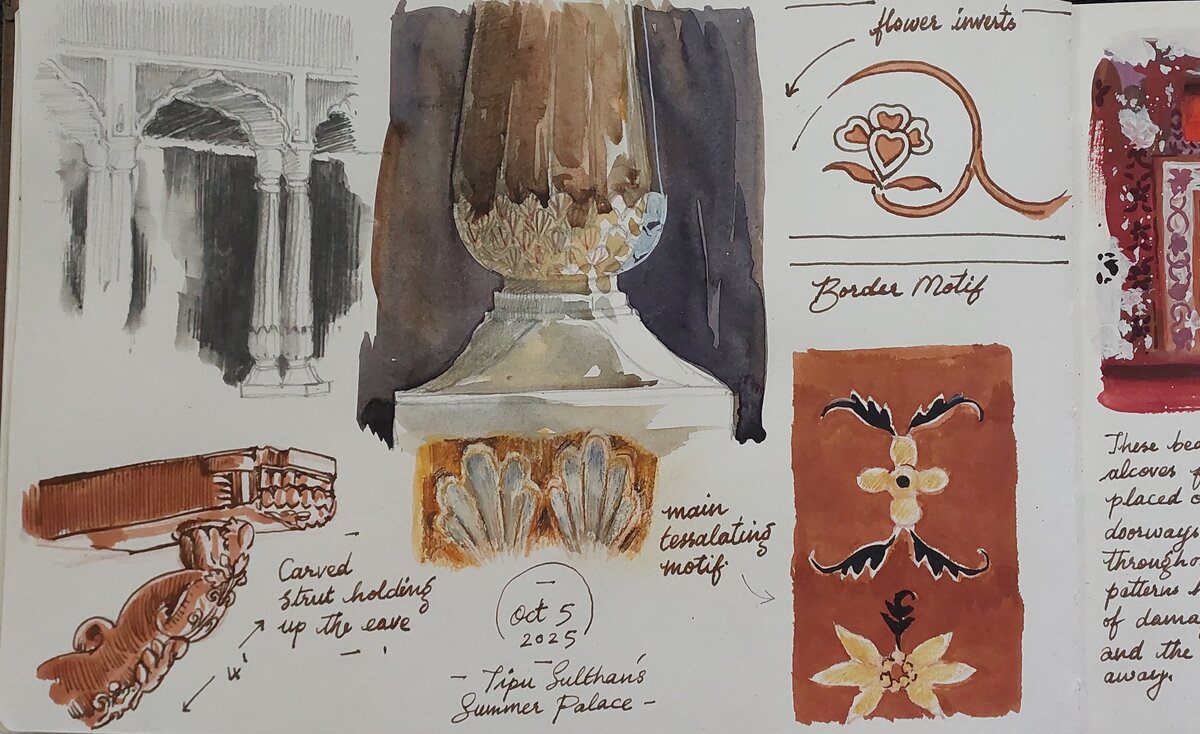
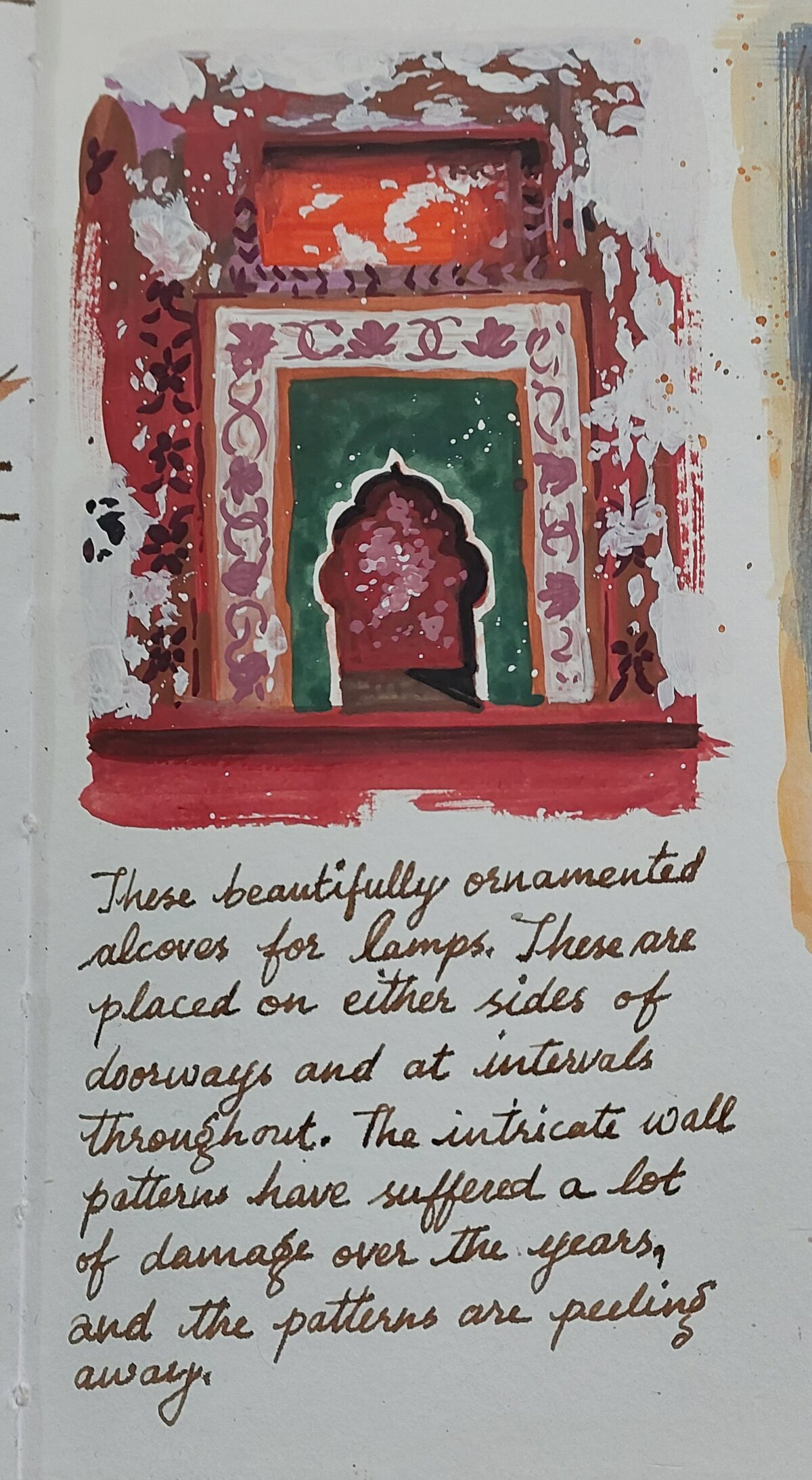
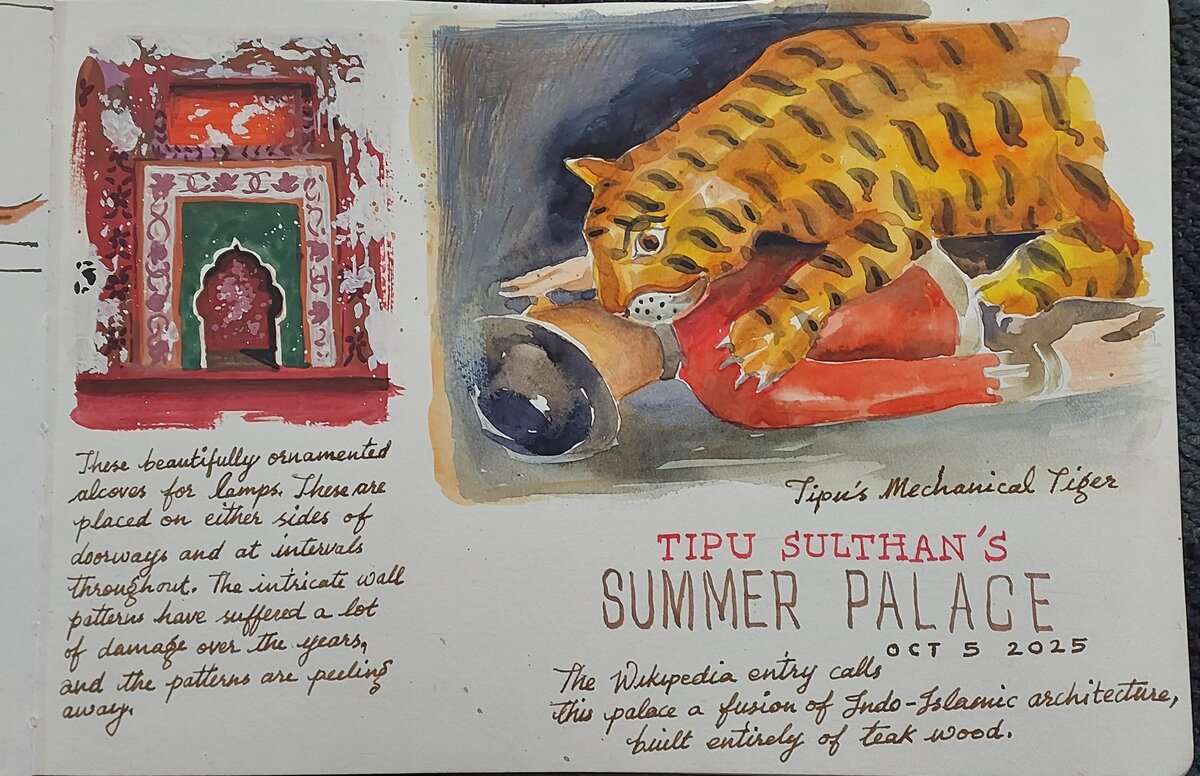
I walked around the inside, trying to visualise what it may have looked like during the reign of the sultan. The pillars caught my attention. The place is full of them. As I drew the pillar, I became aware of the motifs at the base, and suddenly all I could see were the motifs. The carving on the staves of the pillar, the flowers painted on the walls, adorning the borders of alcoves for lamps. Everywhere. After that I spent the rest of the jam drawing motifs, and what I couldn’t draw on location, I drew from photographs back in my studio.
I heavily annotate my sketches because it is important for me to add textual context to my drawings. I tend to look up Wikipedia, or do web searches in between spurts of drawing. The drawing prompts the searches and the information from search results informs the drawing.It’s a loop.
Visual density - Dhobi Ghat, K.R Market, Flower Market
I approached the Dhobi Ghat in Ulsoor, the K.R market and the flower market in Malleshwaram in a very different way. At Tipu’s palace, I was attracted by the detail. In these places there was too much of it. As a result, I found myself trying to interpret the overall sense of the space. The visual (and auditory and olfactory) stimuli was overloading my senses, and I wanted to capture the gestalt of it.
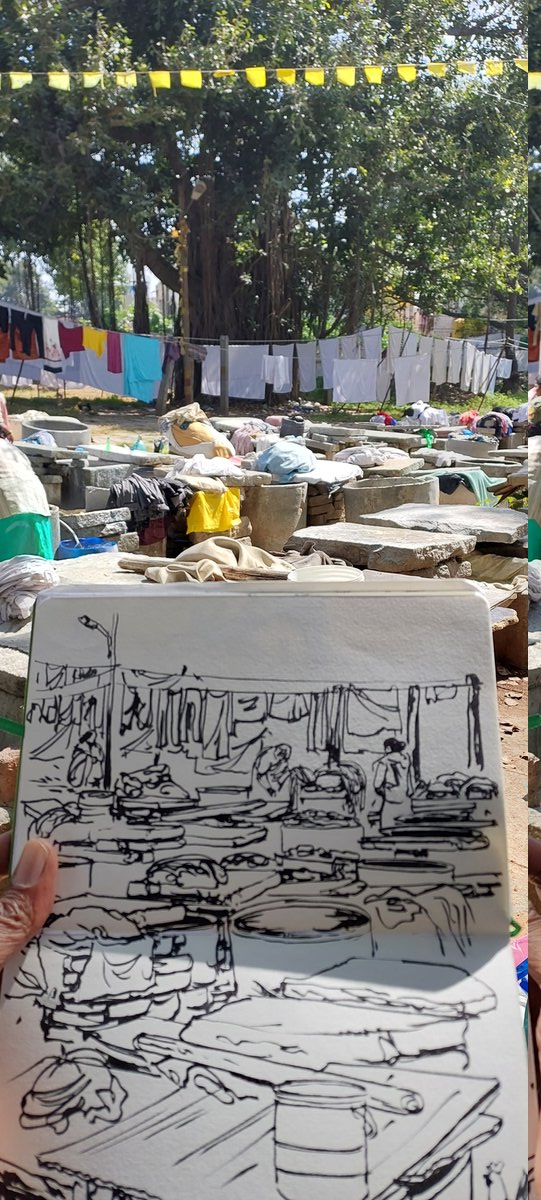
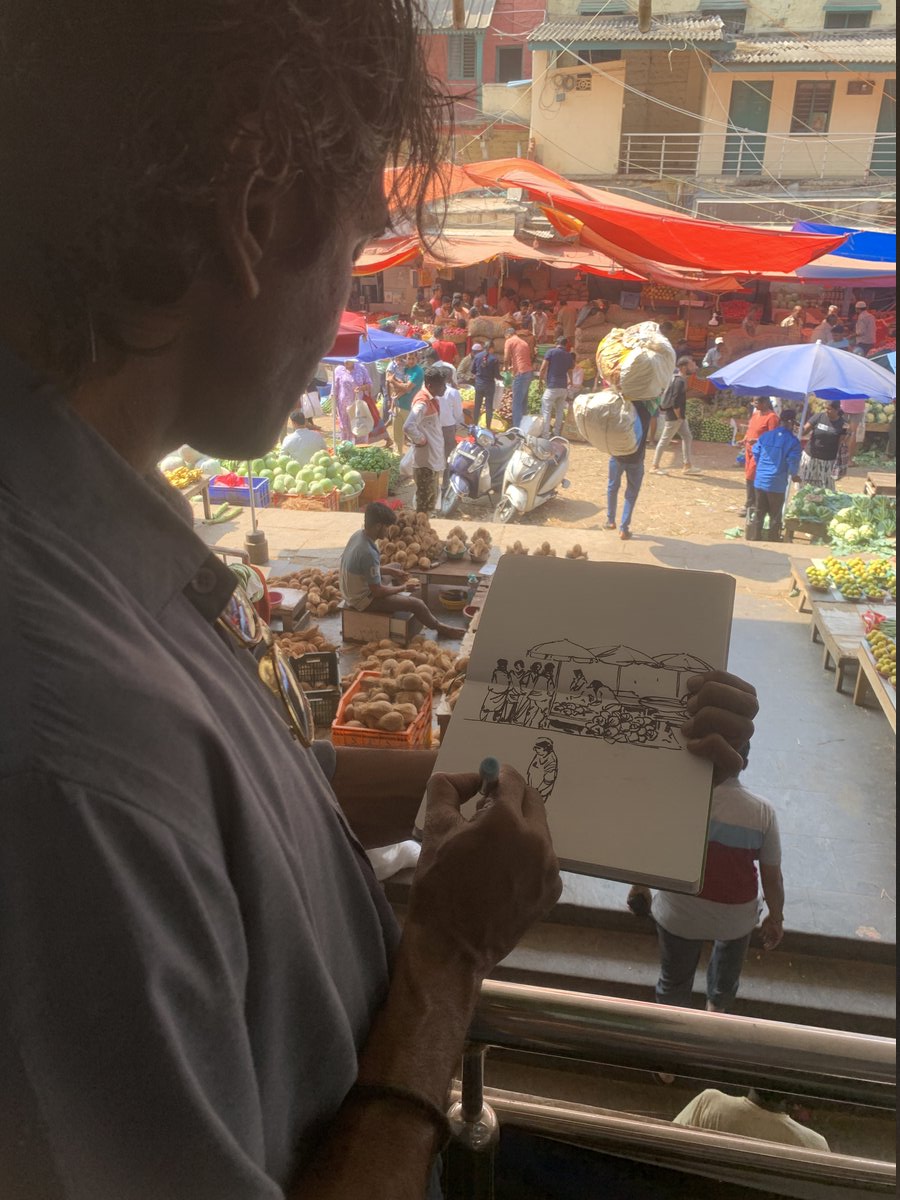
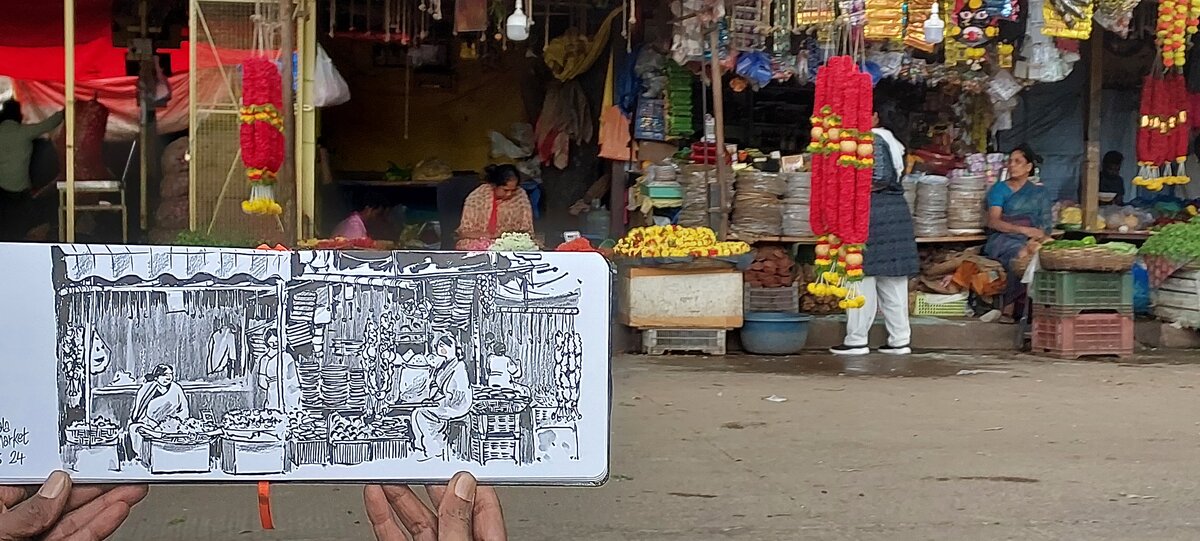
Rather than try to draw individual details, I tried to respond to the overwhelming visuals using denser marks. Thicker strokes of my brush pen. I jumped around the page, packing in details, interpreting the chaos with quick strokes.
I chose a brush over a pen because the fine, hard line of a gel pen slows me down. It forces me to observe detail. With a pen, I become deliberate.
The mad rush of the Dhobi ghat and the market demanded a brush. A brush is malleable. I respond faster to visual stimuli because a brush makes a variety of marks of varying thicknesses, while the pen is restricted to the thickness of its nib.
I can switch between fine lines and broad ones. I can smudge and smear. I can twirl the brush, for instance, to create a mark that looks like the twisted clothes on a dhobi’s washing stone, or a mound of flowers in the florist’s basket.
As a consequence, my drawings become loose, my eye (hand) does not rest at any one point, which lets me move faster than if I drew with a pen.
Folk Dancers - Movement and Energy
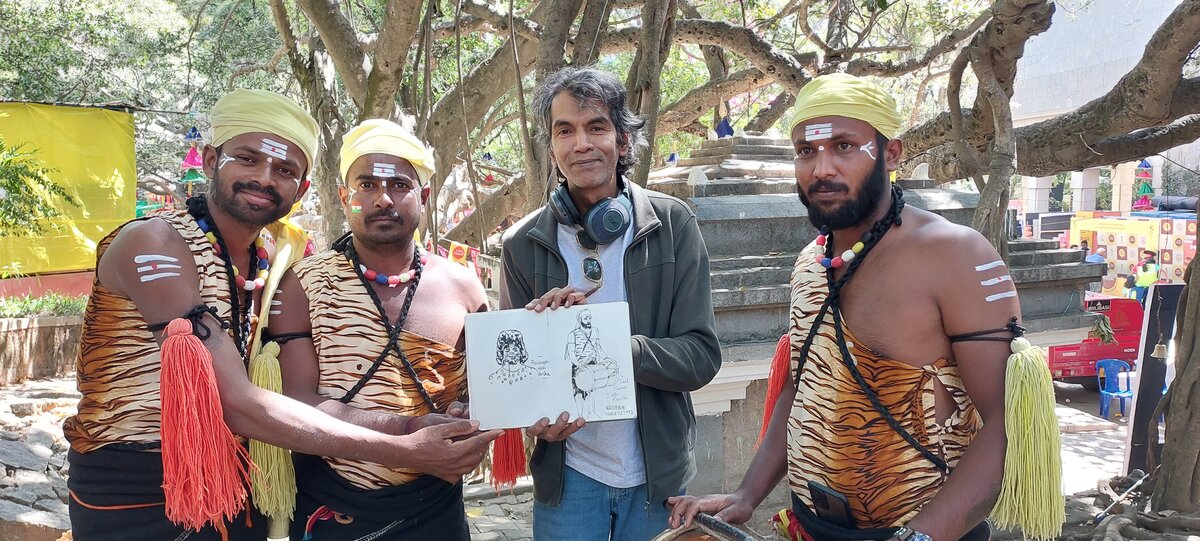
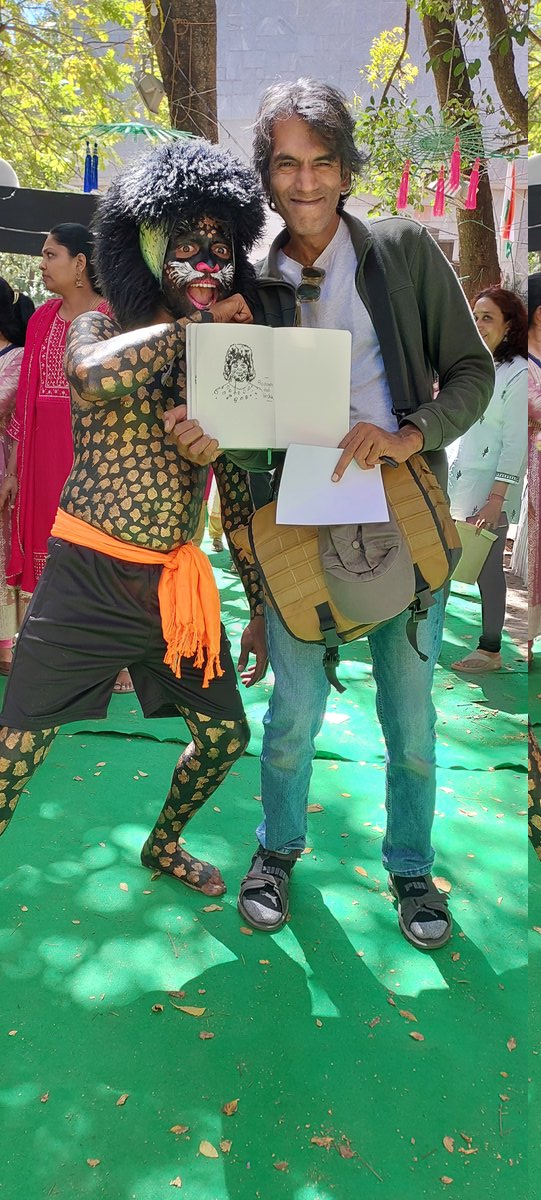
I drew these folk dancers at the Chitrakala Parishath during a jaathre. Traditional folk dancers make for interesting subjects. Their fabulous costumes, the colour, the exuberant energy. Drawing people, especially artists is different from the previous two scenarios–the palace and the markets. What matters when drawing people is the ability to draw form in action. The pose. The body language of the subject.
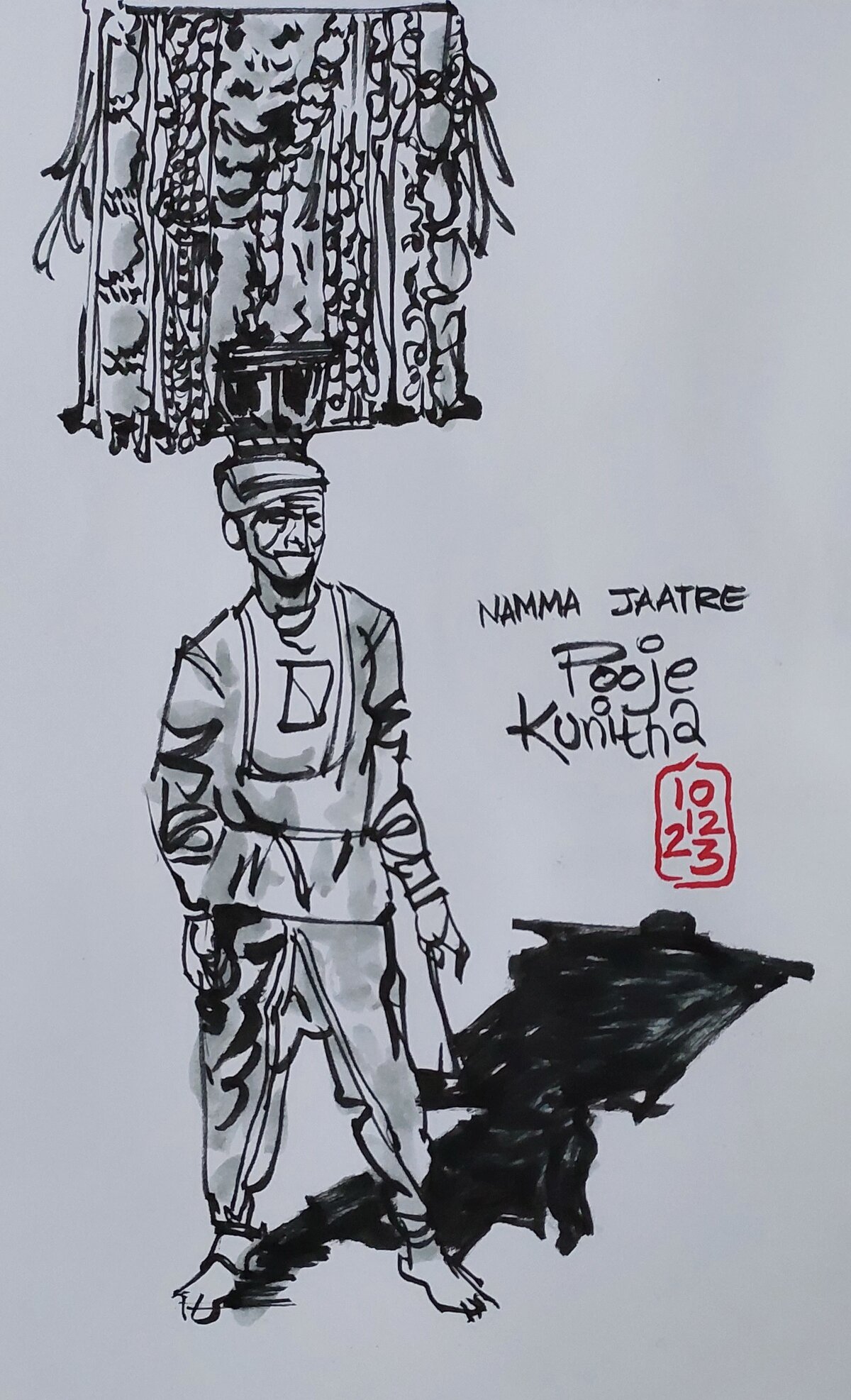
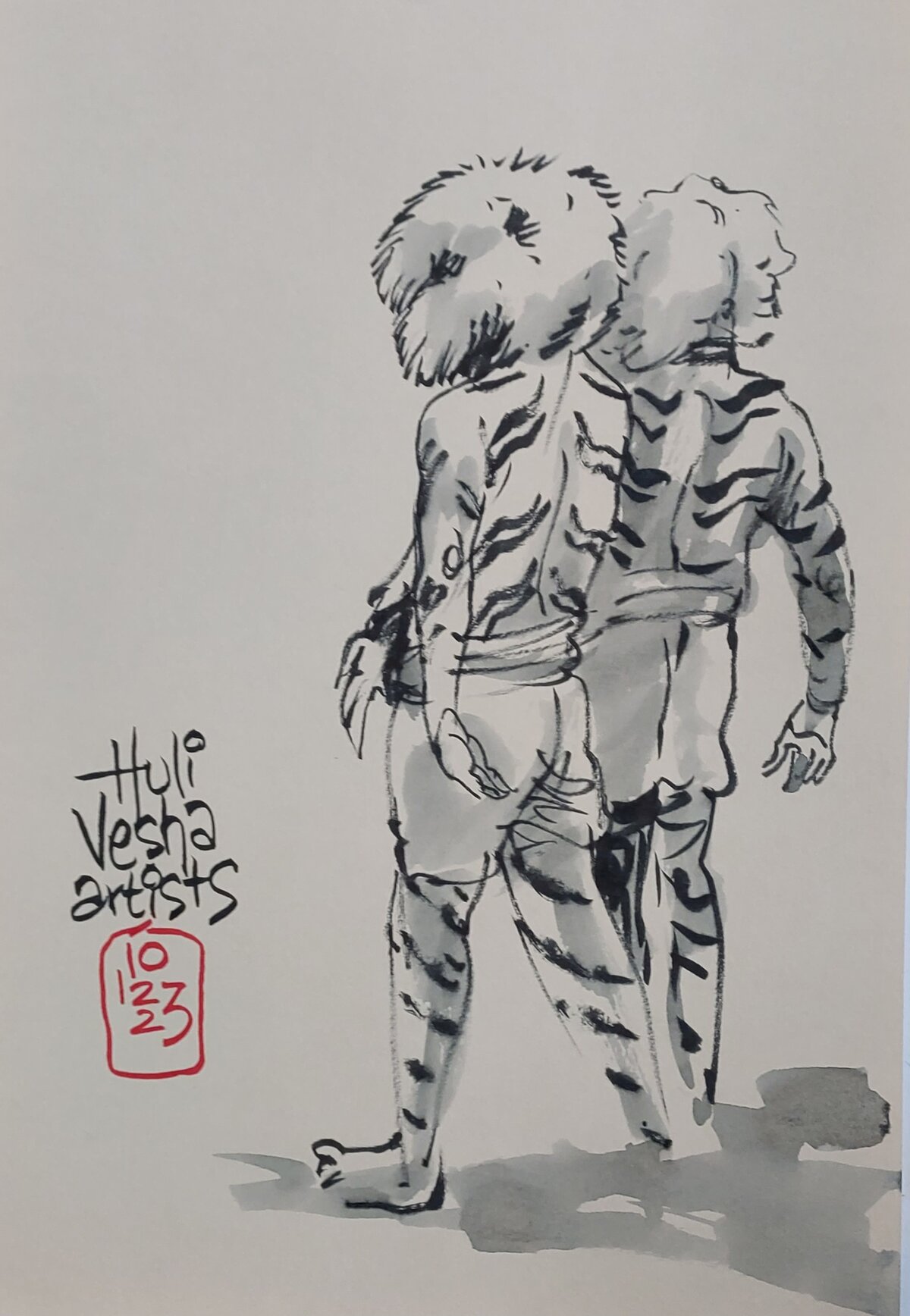
Gesture drawing is a way to try and capture movement. I used a brush pen because it adds personality to the drawings, and also for the economy of marks I get from it. Brushes are great for drawing moving people. (Sometimes if the person is seated or does not move much, I prefer a nib–a fountain pen, for its precise detail.)
The two drawings–the Pooje Kunitha and the Huli Vesha–are examples of what I focus on when drawing people. The Pooje Kunitha artist is balancing a heavy kalasha with an elaborate bamboo grid festooned with flowers and ornaments. I tried to get the slight tilt and sway of his body right. With the Huli Vesha artists I tried to capture their swagger, as they walked around the CKP campus like their namesake–tigers.
Interpreting movement is a bottom-up process (I think). I don’t watch for specific body-language. I try to take in the overall sense of form and movement rather than try and assemble body parts into a complete figure. I look for shapes and try and watch how they change as the person moves.
The other thing about drawing people is learning from conversations with them. The dancers I drew were curious enough to come over and strike up a conversation. (Perhaps it is more flattering to be drawn than photographed?) This lets me conduct friendly interrogation. I ask about the dance form, their costumes, where they are from. These stories go into my sketch journal.
So, drawing is never as straightforward as setting lines on paper. There is this dynamic between me, the tool and the subject. Each element feeds off the other. What happens within (my mind) is interesting. Research seems to suggest that when I am drawing, I suppress automatic responses, which helps me focus more on the subject.
One example is labeling. Regular human behaviour is to label the things we see. We say. “That is a pilot, that is his helmet, those are his arms” and so on. The problem with labeling things is that we no longer see that thing, instead, we see what we think (or are told) ought to be there.
Labeling also interrupts flow. I’ve noticed that when I am in a flow state, I’m not aware that I’m solving a picture-making problem. I’m not aware of contents of my mind. Actually, I’m really not aware of myself at all. This disappearance of the self happens in bursts, sometimes for a few seconds and sometimes for up to five or ten minutes. Others3 in our community have reported similar effects. Flow theory sets forth three conditions for a Flow state to be achieved.
- There must be an end point. A goal.
- There must be feedback
- There must be a balance between the challenge and one’s skill
The third condition seems like the most important point. When the difficulty of the task matches one’s skill, a flow state may be achieved. I see a parallel to this in some of those old Daoist stories. Perhaps this is what Cook Ting4 meant when he says “…now I go at it by spirit and don’t look with my eyes. "
Notes
The reason we label things is because our brains prefer efficiency over accuracy. Labeling something (That thing is a tree) is more efficient than spending time and energy in adding additional detail (That is an artifical Alphonso mango tree which is super-realistic though it seems to be made from fabric and fibre-glass.)
The free-energy principle theorises that since the brain is a prediction machine, it makes predictions on what we are perceiving based on our past experiences. These expectations are updated only when we realise that what we are seeing is not what we expected. This quick’n’dirty method of processing ensures that the brain minimises prediction errors and also conserves (time and) energy. ↩︎
When I say seeing is automatic, I mean that it is so quick, we are not aware of consciously forming the thought. Research shows that when faced with making a decision, these is predictive activity, a yes side and a no side, each of which build up enough potential, until one of them has more than the other, at which point the decision is made. This final decision happens so fast, that for several years some researchers were convinced that we possessed no free will. Here is a great video explaining Benjamin Libet’s experiment on free will and action potential. ↩︎
One member of our community, an Art educator, told me that when he is drawing at his studio, his smart-watch reports that he is in a state of deep sleep. ↩︎
The Cook Ting was cutting up an ox for Lord Wen-hui. As every touch of his hand, every heave of his shoulder, every move of his feet, every thrust of his knee — zip! zoop! He slithered the knife along with a zing, and all was in perfect rhythm, as though he were performing the dance of the Mulberry Grove or keeping time to the Ching-shou music.
“Ah, this is marvelous!” said Lord Wen-hui. “Imagine skill reaching such heights!”
Cook Ting laid down his knife and replied, “What I care about is the Way, which goes beyond skill. When I first began cutting up oxen, all I could see was the ox itself. After three years I no longer saw the whole ox. And now — now I go at it by spirit and don’t look with my eyes. Perception and understanding have come to a stop and spirit moves where it wants. I go along with the natural makeup, strike in the big hollows, guide the knife through the big openings, and following things as they are. So I never touch the smallest ligament or tendon, much less a main joint.
“A good cook changes his knife once a year — because he cuts. A mediocre cook changes his knife once a month — because he hacks. I’ve had this knife of mine for nineteen years and I’ve cut up thousands of oxen with it, and yet the blade is as good as though it had just come from the grindstone. There are spaces between the joints, and the blade of the knife has really no thickness. If you insert what has no thickness into such spaces, then there’s plenty of room — more than enough for the blade to play about it. That’s why after nineteen years the blade of my knife is still as good as when it first came from the grindstone.
“However, whenever I come to a complicated place, I size up the difficulties, tell myself to watch out and be careful, keep my eyes on what I’m doing, work very slowly, and move the knife with the greatest subtlety, until — flop! the whole thing comes apart like a clod of earth crumbling to the ground. I stand there holding the knife and look all around me, completely satisfied and reluctant to move on, and then I wipe off the knife and put it away.”*
“Excellent!” said Lord Wen-hui. “I have heard the words of Cook Ting and learned how to care for life!”
Translated by Burton Watson (Chuang Tzu: The Basic Writings, 1964) From here ↩︎