My writing tool is like an anthill

T
he irony of my situation is that at first, all I wanted was simple, distraction free software to write in. I started using software for writing in the late 90s, with a pirated copy of Microsoft word, on a rented Pentium 4861. Word processors were all I knew for many years until I discovered Linux and one day, Pyroom.Pyroom was great. Perfect actually. It worked with text files, and the screen had nothing but a black background, with green text. It was very cool and I should have stopped looking right there, but a couple of years later, Focuswriter caught my eye. It had more features, more bling, and it had a sound effects! It played typewriter sounds. Clickety-clack. Ching. It annoyed the hell out of people working near me, but I loved it.
I stuck with Focuswriter for a while, then one day I discovered sweet, sweet Zim-wiki. I used Zim for close to 13 years, and I put all my text into it. Emails, meeting notes, research, clippoings and snippets, articles and blog posts. Zim also had a distraction free mode which I enjoyed very much. Zim was everything I needed in a perfect writing environment. It was a wiki, so I could link pages. I could export to Markdown and HTML. I could even store my tasks in it.
Then, one day, to my utter delight and eventual, eternal damnation I discovered Emacs.
Emacs claims to be a text editor, which is like calling an excavator, a spade. Technically true, but also misleading. The term editor when describing Emacs is a very broad umbrella. So broad, it involves managing and manipulating text as prose, code, email, feeds, plans, ledgers… anything that can be expressed in textual form, Emacs can create, manage and edit.
As a result, Emacs has replaced a whole bunch of different software I use, and in a crazy way. It’s like the Invasion of the Body Snatchers. Emacs took over their corporeal bodies and pretends to be them.
This started with Zim-wiki. Over many years, I wrote thousands of notes in Zim, and I did not want to have to convert them. What I did instead is recreate all of its main functions–the syntax, the link format and all that in Emacs. Now my Zim notes aren’t aware they are being opened, linked or edited by Emacs, and if I open them in Zim, they behave as though they were created right there.
I did the same thing with Logseq, because I make notes using that on my phone. I just recreated its main conventions and functionality within Emacs. Ditto with Obsidian and I also used Org-roam for a while, so that’s a part of this weird notes app soup as well.
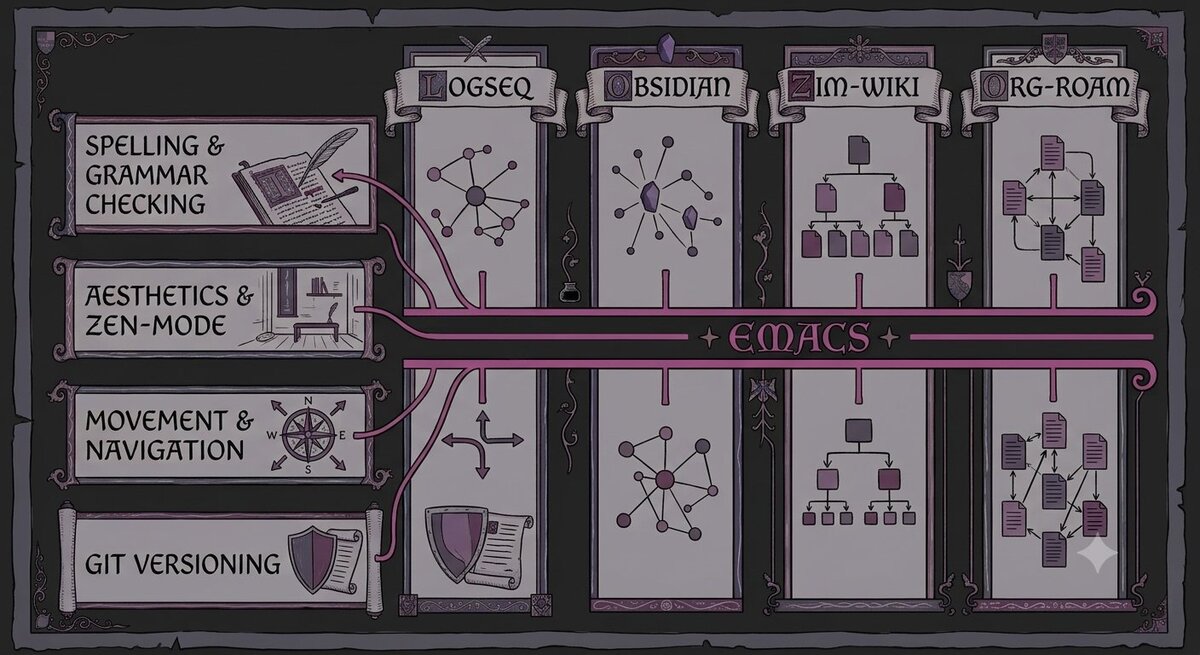
What I have on my hands now is something that looks like the cross section of an anthill. Chambers leading to labyrinthine tunnels leading to more chambers and tunnels. My notes are spread across different Note-taking software and Emacs rules them all.

This is madness. Of course, it is. But in the world of Emacs, this makes perfect sense. If I were using any other note-taking or writing tool my concerns, when I’m switching over to a new software would be, “where is the export option, so I can port my old files over” or, “how different are the features in my new software” and mostly “how long before I dump this one for the next shiny thing?”.
In Emacs, I just smoosh the features of all the software that came before Emacs into a frankenstein monster and it works. Really well I mean. It works really well.
The way it works is that notebook management is orthogonal to writing. Which means that the helper functions for writing such as spelling and grammar checking, tooling for aesthetics such as distraction-free editing, functions for navigation and movement, Git tools for versioning and so on are available to all my notebooks.
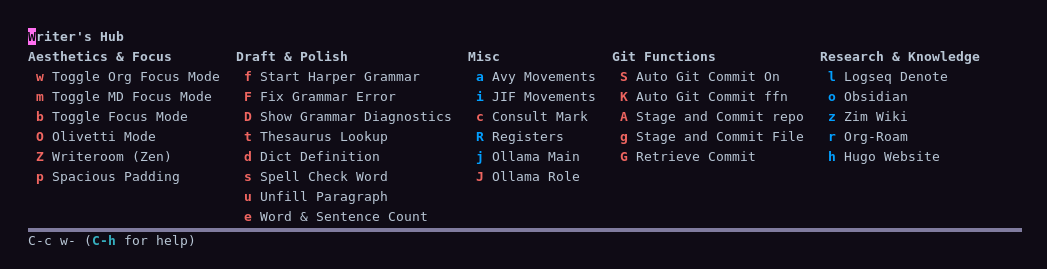
The end result is a a surprisingly smooth workflow for writing. I showed my wife my setup and she lost her patience just listening to me explain it. I don’t blame her. It looks and sounds loony af, but it works for me.
I stopped writing this post long enough to find and install Focuswriter to see if I could recall any of the magic I felt when I first used it. It’s still pretty. Still Rock solid. But. It’s not Emacs. The magic is gone.
Someone had once written on Reddit that Emacs has colonized his brain. I get what that feels like. I live in this strange anthill, an experience that I have so much trouble describing to people and which, to my delight (and dread) I never want to leave.
Back then, (roughly, three decades ago) people used to run shops that rented computers. These machines had pirated software loaded onto them. They constantly hung or crashed. I think I paid about Rs.2500 a month for one of these because I had started a small design firm and couldn’t afford to buy a computer yet. ↩︎