Making sense of Zettelkasten
When I first came across the concept of a Zettelkasten I waved it away as a fad. Actually, no. I didn’t just wave it away. I waded into the deep end, read extensively, joined the community and eventually came to these conclusions:
The emphasis on constantly curating, pruning and connecting notes seemed like too much work. Better suited to academics or researchers who naturally live in their notes.
The emphasis on atomic notes that stick to one idea for each note seemed excessive. Supporting ideas provide context. Should they not occupy the same space?
Finally, the digital version of Zettelkasten felt like old wine in a new bottle. Like I’m rereading Ward Cunningham’s idea of a Wiki or NV’s advice on maintaining one fact per note. At that point I was already using some of the ideas that practitioners of Zettelkasten propose, such as unique identifiers, or a single folder for all notes, and it felt like the system was not offering me anything new.
So I stopped there. I already had a decent wiki, and a collection of notes that I could easily surface using search. I didn’t need yet another system, although there was one major difference - A zettelkasten is meant to contain ideas in my own words but the notes in my collection were not all written by me. Most of them I clipped from interesting articles I came across.

A decade has passed since then. I recently became aware of the Zettelkasten again, but this time and it makes sense. Maybe the time away from it has clarified my thinking.
At the time, I misunderstood the nature of a Zettelkasten. I approached it as a note-taking system, which led me to compare it with my existing system. While it technically is a way to take notes, calling it a note-taking system obscures the essential point of a Zettelkasten, which is that the act of regularly working on your notes is the physical equivalent of sorting through your thoughts and refining them.
So anyway, here I am, revisiting my conclusions.
Why does a Zettelkasten demand so much time and effort?
I realise now that a zettelkasten does not replace my existing collection of notes. It is a different animal altogether. My usual notes are for reference. I only look at my notes when I need to find something that I know is in there. These notes can go untouched or unseen for months.
A zettelkasten on the other hand is a system that requires my complete attention and constant work. Every new idea added in there has the potential to change, replace, support, extend, contradict existing ideas. This means that nothing in there is ever static, I am constantly rearticulating ideas, redefining statements and so on.
Say I have a note on the German word - Schwerpunkt, which as I understand it, translates to ‘focal point’. After a few days and some more reading, I realise Schwerpunkt does not mean focal point, in the sense of a point of attention, but that it also means the point at which one concentrates effort. Now I’d have to go in and clarify what I was trying to say, update my understanding of the subject and also update the links to other notes, because my understanding of the idea has broadened.
Why are all notes stored in the same folder
Folders provide an easy way to create categories. Categories make sense because it lets us lump things that (we think) belong together, which on the surface of it sounds logical, but it also affects the way I think. If I think something belongs in one category, it becomes hard to also think of it as belonging to another category. Last year I heard about a field called computational neuroscience. Does that come under the category computing or is it cognitive science? If I create a broader category called interdisciplinary, it will eventually become a holding category and i’m back where I started.
Since a Zettelkasten is a personal store of information, we can do away with strict categories. However we do need a method to identify subjects and their domains so we can sort notes if we need to. Tags are great for that. A note can have more than one tag, signifying that it is related to more than one domain.
The other advantage of storing everything in the same folder is the way cross-pollinating of ideas happens. Since my notes are not bound by folders, seemingly unrelated, yet tangentially related ideas collide.
An example.
Notan is a technique used in art that reduces the values (shades of light and dark) in an artwork to just two - black and white. Creating a Notan forces you to think about how readable an image is when it is stripped of mid-tones which provides elements with 3D form and volume.
My entry on Notan left me thinking about another concept buried somewhere in my notes that had a ‘similar flavour’, but I wasn’t sure exactly what it was.
I found it eventually. I was thinking about a theory called Collapsing Choice (CCT), which argues that our brains find it difficult to make a reasonable choice when there are too many options. So it collapses the number of choices into simpler, binary buckets. This makes decisions easier.
What does Notan have to do with CCT? I think I saw Notan as an analogy to CCT because they both involve collapsing choices for controlled decision making. I’m not sure if this connection is meaningful to anyone else but me, but I think it improves my understanding of both ideas.
My system actually doesn’t care if there are folders. It surfaces notes from across folders, but I think visually having these notes in one folder promotes the kind of cross-category thinking I described, even at the risk of category errors.
Why are notes atomic?
The notes are atomic to make them modular. If an idea is modular, it means that I can use it as building material to define other ideas.
Say I have a note with this entry:
“Patternicity is a human tendency to find meaningful patterns in random data.”
This idea can become a building block that can fit into a number of different ideas from across disciplines.
I could use it to discuss Leonardo Da Vinci’s advice to artists to on studying stains on a wall, to see in them landscapes and faces and animals. Or in a note about Pareidolia as an evolutionary mechanism that uses low-cost pattern recognition for survival, or patterns in information theory, as a way for our brains to compress information.
The brevity of such notes requires them to hang on a scaffold or a mesh (but not a tree), alongside other notes because they become more meaningful when seen alongside similar or contrasting notes.
Links between notes is what creates this scaffolding. A note can have as many links as it needs. So you start with a note and then follow the link through a series of notes. Depending on the number of links in the note, the pathway can be different each time. It is hard to appreciate the non-linearity of this sort of ’link walking’, until you see your notes as a graph.
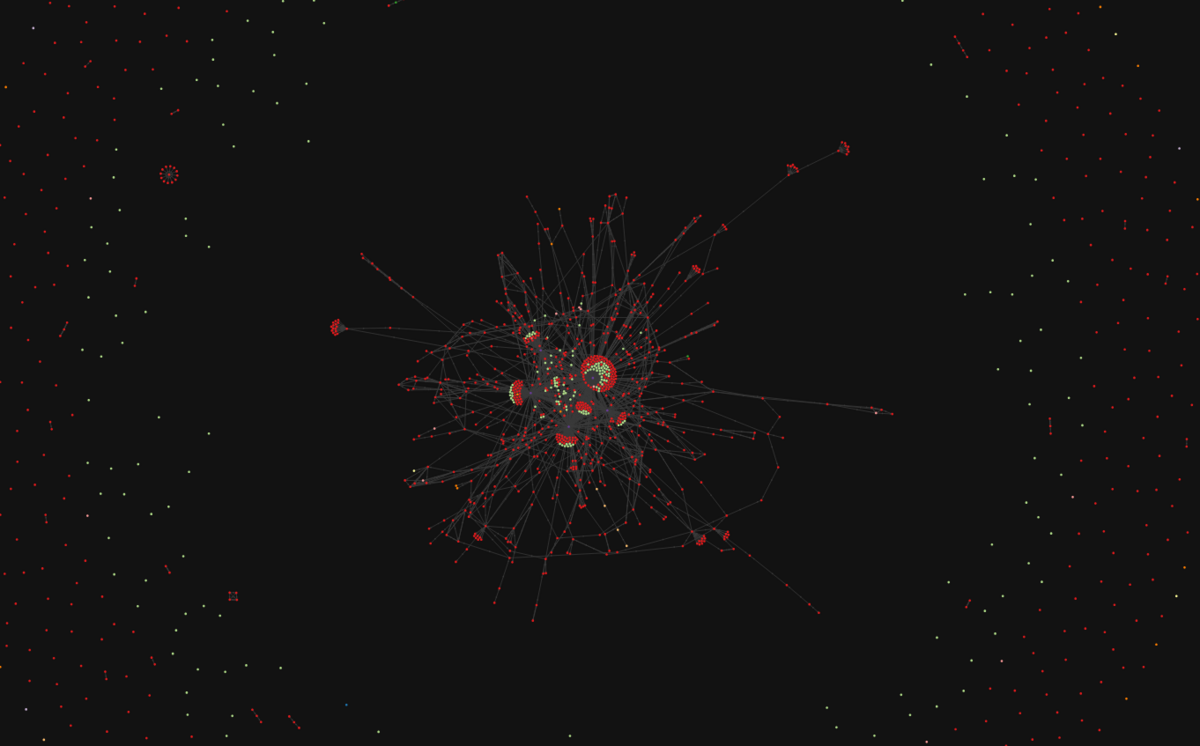 The denser collections at the centre are due to index pages which contain more links than my regular notes1.
This sort of non-linearity lets me make connections between seemingly unrelated ideas, and turns the strict boundaries between subjects and disciplines into fuzzy areas where new ideas are born.
Building a Zettelkasten
Building a digital Zettelkasten does not need much. The most basic digital implementation of it only requires a text editor. Most modern operating systems already offer file explorers with excellent search capability. So you open a folder, create a note and save it. When you need to find a note you browse through the folder. When you have to link two notes, you copy the file-name of the note you are linking to, and paste it. That way, if you have to find that linked note, you can simply search for it in the search bar of your file explorer.
Unlike my regular note-taking method which relies on speed, working on a Zettelkasten is a much more sedate and thoughtful process, so there is no reason this simple method would not work.
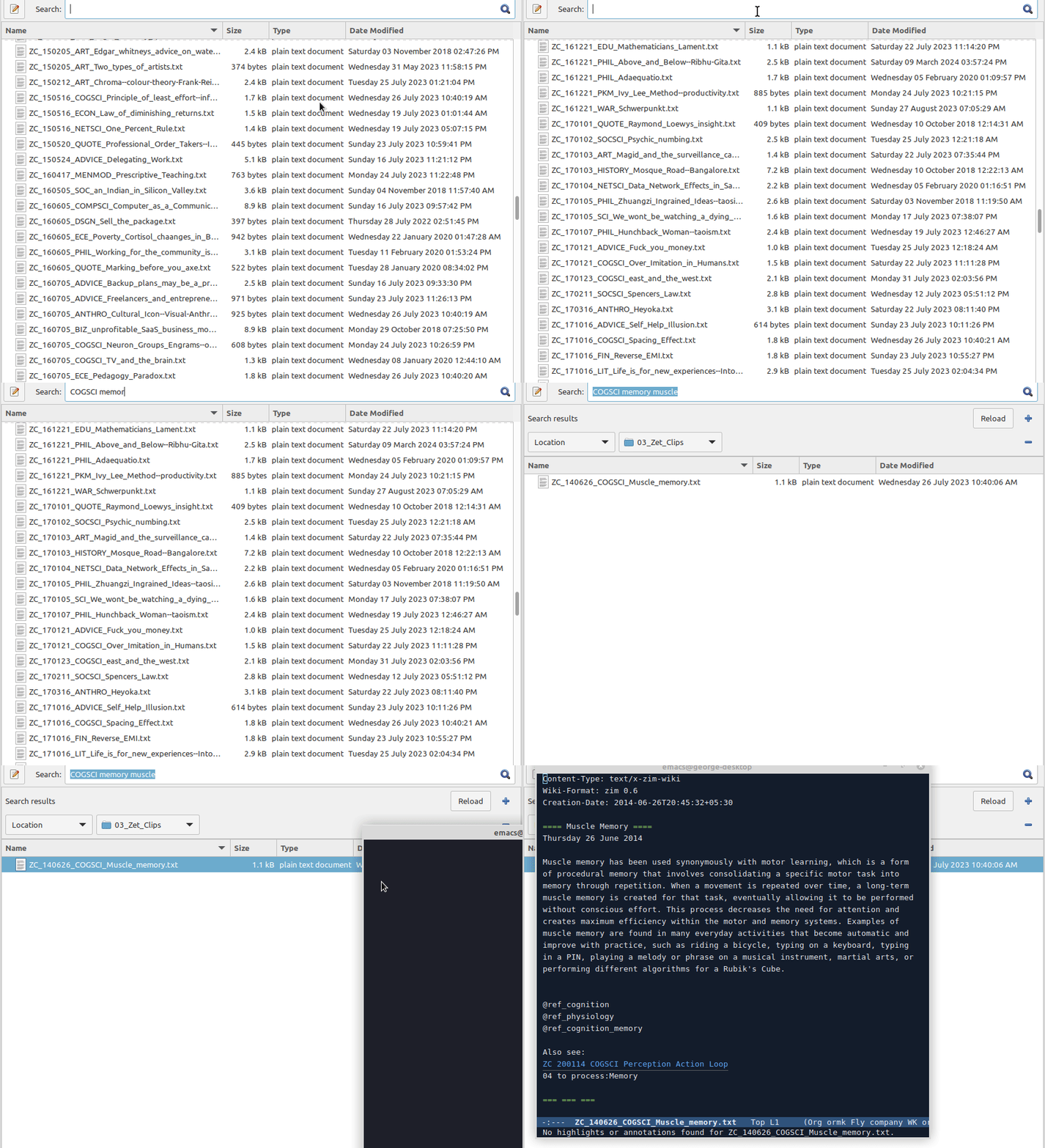 Here is a folder containing my clippings. I am using a file explorer to search through them and a text editor to open and edit a note.
While this sort of manual maintenance of the Zettelkasten is possible, there are ways to automate a lot of the mundane organisational and maintenance tasks by using freely available tools such as Logseq, Tiddlywiki or Obsidian. I use Emacs because I’ve grown used to it.
What I’ve learnt so far is that writing in the Zettelkasten requires me to commit to it. It isn’t a fire and forget system like my other note taking system, which now lives in nervous proximity to my newly created Zettelkasten folder.
The commitment it requires is reflected in how much longer it takes to create a note now. Mostly because I write and then rewite until I think I am being articulate enough for future me. It takes effort, and it is also oddly, fun.
I’ll write again in a year or so and let you know if it stuck.
Notes
Just to be clear, this is not my Zettelkasten, just my large folder of trivia gathered from things I read. My Zettelkasten is still in it’s infancy. ↩︎