02 How design thinking got its woo-woo

In part One of this series, we explored how design-thinking evolved from design, specifically as a meta study of the design process, and how it has come into its own today.
In this part we explore the history behind what makes design-thinking the weird concoction that it is.
Table of Contents
A case against cosmetic design
It was in 1990, I was just coming out of my teens, and in art school when I came across a photocopy of Victor Papanek’s book from the 1970s - “Design for the Real World.” I remember his disappointment with design graduates going on to become aestheticians, dabbling with cosmetic design instead of solving real world problems. Many designers from his time didn’t take that too well - in the golden age of prosperity, the design world didn’t like to be told not to chase profits at any cost. He was apparently described by Design Magazine as “disliked, even loathed by his contemporaries.”
Today we remember him as a designer and teacher who understood the need for compassionate, inclusive, sustainable design.
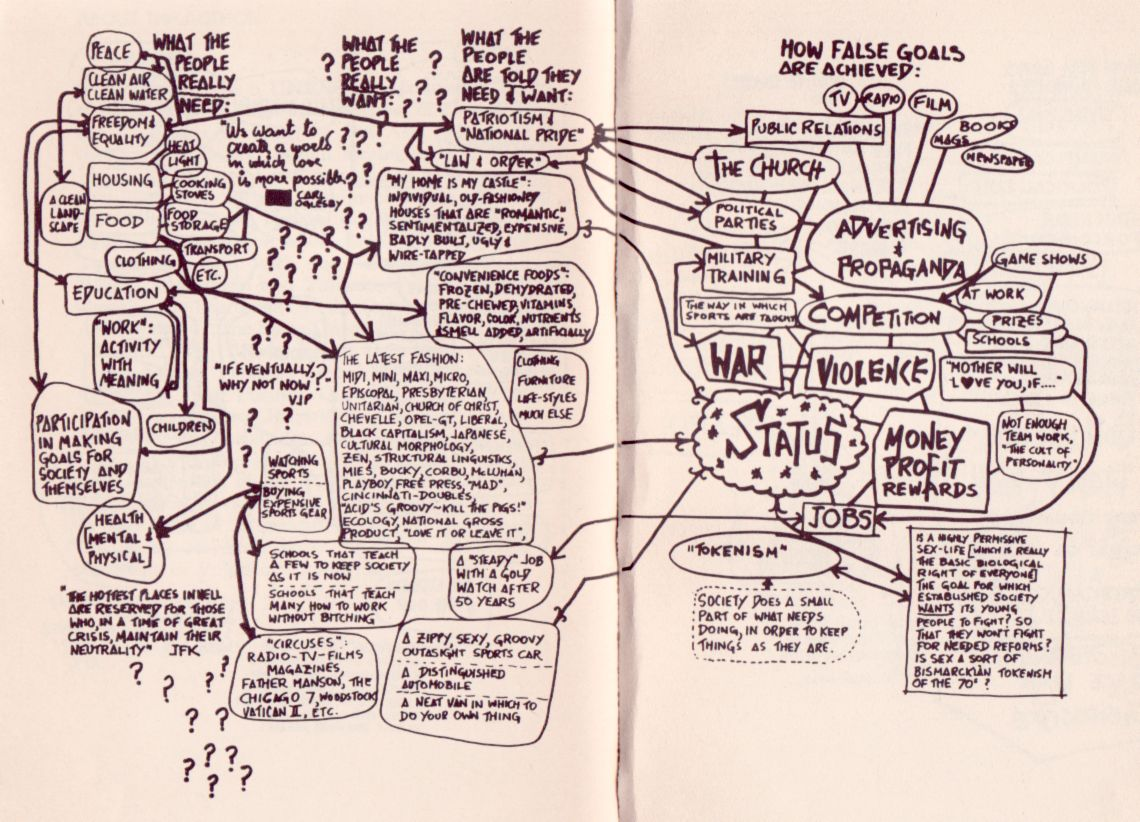
A diagram of needs by Victor Papanek from the 70s, shines light on his integrated, holistic thinking about designing for human needs.
If Victor Papanek could see us today, he wouldn’t just be disappointed, he’d be outright disgusted. Not only did we become even more concerned with inane cosmetics and styling, we went a step further - we created a new kind of ideology that makes it OK (maybe even necessary) to create inconsequential and superficial design solutions and call them innovation.


A brief flashback to part 1 of this series
In part one, we discussed why designers have trouble fitting design-philosophy into the super-efficient, Taylorist minded management theories of today. What started as time and motion studies in the late 1800s (breaking down a job into its component parts and measuring time and effort for each part) has today become the credo of managers everywhere and the driving force behind the modern organisation - optimising for productivity by atomising work and people into components and roles. Readers who have some background to complex systems and the idea of emergence will understand what happens when you look at a system as only the sum of its parts and how damaging it can be to sub-optimise a system.
Design on the other hand, has its roots in situated practice, and under-girded by situated cognition. It is like asking writers, where they get their ideas from. (From practice, where else?) But this is very hard to break down in the language of the vastly more analytical and empirical language of management theory, and as a consequence the design department has remained in the background, and away from the strategy table. We did not have a bridge between these two cultures until something unexpected came along. A phenomenon called design-thinking.
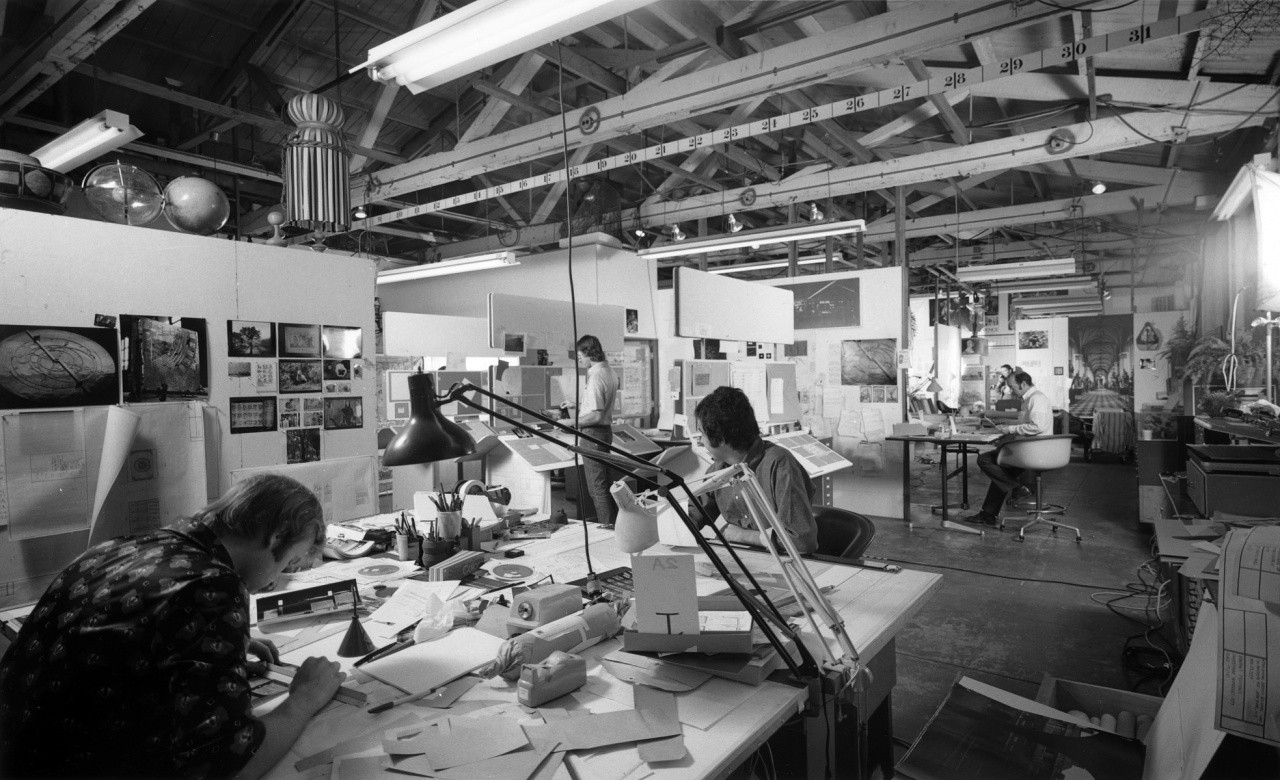
The Eames Studio - What spaces that support situated practices look like.
Now, I’m not saying that design-thinking set out to bridge these two cultures through some purposeful seguing, instead what is happening is, I think simply emergence - the FOMO of the next big management fad is getting people to at least take notice of how designers work. This apparent blessing doesn’t come fully assembled though. For the bridging of these two cultures to take place, its not enough for just managers to give design-thinking a spin. Designers have to meet managers halfway as well, and one way to do it is to start thinking like Management consultants.
Designer time VS Consultant time
I first came across this distinction in 2000, when I worked as a contracted head of Information Architecture in the ‘E-Health’ division of a Pediatric hospital in Cincinnati. I had just arrived from Bangalore, taken a look at my task-list and belted out everything that needed doing over the next couple of days. Shortly after, a project manager from Arthur Andersen consulting took me under his wing and taught me the difference between designer time and consultant time.
See, the designer bills for time-to-generate, the consultant bills for that and (i’m paraphrasing) also for “developing a coherent business narrative that reflects the necessity of these tasks as fundamental drivers in the phase change that will help the client-organisation shift into the new e-Health paradigm through real-time web technologies built around patient-centric information structures.”
It didn’t take long for me to learn the ropes of consulting, and I suspect many other designers made this leap as well in the late 90s and early 2000. The catalyst was web technology and the dotcom boom. Pretty soon I was doing very little generative work and most of my time was taken up with interviewing client stakeholders, building elaborate business cases, pitching consulting interventions and creating project plans for my team.
IDEO too jumped out of mainstream design and into management consulting around this time. In the 90s, American companies designed their products at home and outsourced production to Asia, primarily China and it was only a matter of time before Asian countries started bundling design services too. IDEO was among those companies that began to feel the pinch. Their machine shop, the place where IDEO’s designers get their ideas converted into actual prototypes shrank from 26 people to just 6. In early 2000s, under pressure from Chinese competition, IDEO started seeking new sources of revenue. They settled on Strategy consulting, the kind provided by the likes of MicKinsey and other management consulting firms.
As a former IDEO employee explains under conditions of anonymity “They started saying, ‘okay, now what do we do?’ Where was there still opportunity to charge rates? They saw McKinsey and some of those other [management consulting firms] making money…for strategy or report kinds of things.”
He sums up IDEOs leap from designing things to consulting with the C-suite saying “There’s been a shift to less mechanical and to more mystical.”
So, designers became consultants. Is that a bad thing? Not if we are aware of what is happening around us. If we do this right, a design historian looking back at this period, a 100 years from now will remember design-thinking as the nudge that moved design from a generative field to a intellectual, consultative field.
Design-thinking - Part Design, Part Management Consulting, Part Woo Woo
Before we step into the future though, we need to go into the past. We need to look at how design-thinking became this humanistic nudge in the first place. What is design-thinking doing that other innovation methods had not done before. (Also, as an aside for the engineering minded managers- Why is design-thinking so screwy? And how come organisations are not only tolerant, but actually integrating its woo-woo into management science.) To understand the weird and combustible cultural mixture that is driving the adoption of design thinking, we need to examine its three main parts. The Brain, The Heart and The Soul.
- It takes a Management Consulting Approach to Design interventions. It’s Brain
- It builds on observations of Design Practice and How designers think. It’s Heart
- It is underpinned by an exuberant faith in the untapped potential of human beings. It’s Soul
In part one, I already covered ground on the Heart, that is, how design-thinking was influenced by design. For the rest of this article we will explore the other two parts. The Brain and the Soul of design-thinking. That soul especially is what makes design thinking so humanistic, fun, creative and interesting. It’s also the fly in our soup and we’ll see why in just a moment. (Also, I would not throw the word ‘soul’ around so loosely when talking about design, except that design-thinking as you will see, isn’t all that scientific.)
But first, lets take a look at the witchdoctors of management theory - The Consultants.
Learning from the Witchdoctors
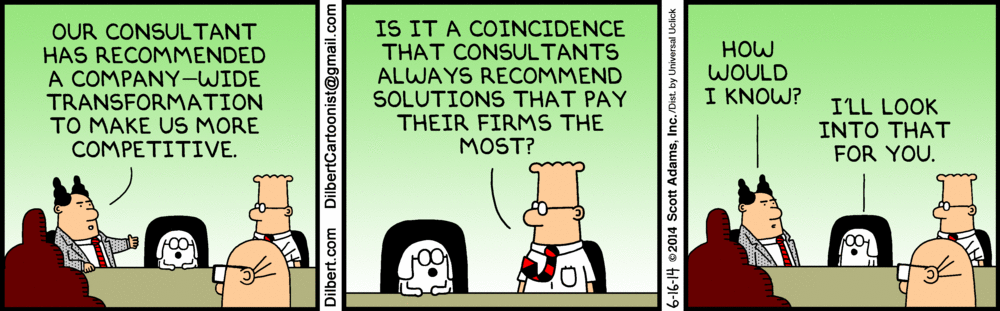
Management Consulting is one of those professions that have had an undeniable impact on the growth of management theory and practice. At the same time though, the popular description of management consultants as “people who steal your watch to tell you the time” isn’t that far off the mark either. Consulting firms, some say, take credit for models and theories that work and when they don’t, they charge you to find out why. Meaning that overdetermination ensures you never really find out if a success or failure was due to the consultant’s advice. Design-thinking, drinks deeply from this well of consulting voodoo.
In an interview with Fast Company last year, IDEO’s Michael Hendrix responded to criticisms of design-thinking’s methods and techniques that they are shallow and unscientific. He talks about how he recalled seeing a door at a client’s office with a sign that read “Creative Thinking / DVD Storage”. He rounds off his observation of this underused ‘creative thinking’ room by saying “Having access to the tools can be a little deceiving if you don’t understand how to use them in an appropriate way…”
Tools don’t make you an expert you say? Gosh!
What he’s inadvertently pointing out here, is that holding a scalpel doesn’t turn you into a surgeon. Or a sharpie into a designer. He also explains away the lack of design capability on the client’s part as though it were simply lack of commitment saying, “We can bring powerful ideas to an organization, but it can just die if there’s not a willingness to take it and develop it in a way that’s effective.” This is not a new response from IDEO about the limitations of design-thinking.
Around a year ago, I attended a talk by IDEO’s David Webster in Bangalore. I asked him since IDEO is such a poster child for design-thinking, would they also take responsibility for its shortcomings. David (uncomfortably) replied, saying IDEO is giving India the philosophy and approach of design-thinking. He wanted to see what we make of it. (We made khichdi of it Dave, if you’re still asking.)
A management consulting mindset to problem-solving produces a helpful buffer of consultative deniability (We provide, YOU decide.) and is perfect for design-interventions that aim at solving ‘high-level’ problems. Those are not the only lessons that design-thinking took from consulting. It also borrowed from the consultants a novel way of speaking about their work. Consultant speak, a round about way to convey information while sounding like a expert, is now ubiquitously spoken in organisations everywhere.

In the 100 odd years that it has been around, management consulting has perfected its formula for growth and it doesn’t seem to be stopping anytime soon.
In The Witch Doctors - Making Sense of the Management Gurus, John Micklethwait and Adrian Wooldridge say…
“Whatever the discipline’s problems, there is no doubt that it will go from strength to strength … There is an even more important reason why the witch doctors will enjoy an ever expanding demand for their services. Even if managers do learn how to thrive on chaos or control their destiny, they will still be confronted by that most intractable of all problems: the cussedness of human nature.”
Co-opting this sort of thinking from the management consulting play-book, helped design-thinking gain a sense of legitimacy in the eyes of the modern organisation. It provided the schools, agencies and trainers promoting design-thinking with a set of assumptions, vocabularies and tools by which they could create a field that is so mysterious and dense that organisations fear they are missing out on a potentially new fad. Also it doesn’t hurt that an endless army of passionate youngsters create demand and can be trained faster than you could say “ummm…don’t-you -need-some-experience-first?” before being sent out to change the world for big bucks.
Bruce Henderson, arguably one of the founding fathers of the modern management consulting firm apparently once said “Can you think of anything more improbable than taking the world’s most successful firms and hiring people just fresh out of school and telling them how to run their businesses – and getting them to pay millions of pounds for this advice?”
The Hasso-Plattner Institut doesn’t think this is too improbable. In fact they seem to have made it the core of their business-model. That familiar old management consulting formula that never fails. First create a market by describing the world as chaotic, complex and turbulent. Then offer a life-raft to navigate those hostile oceans.
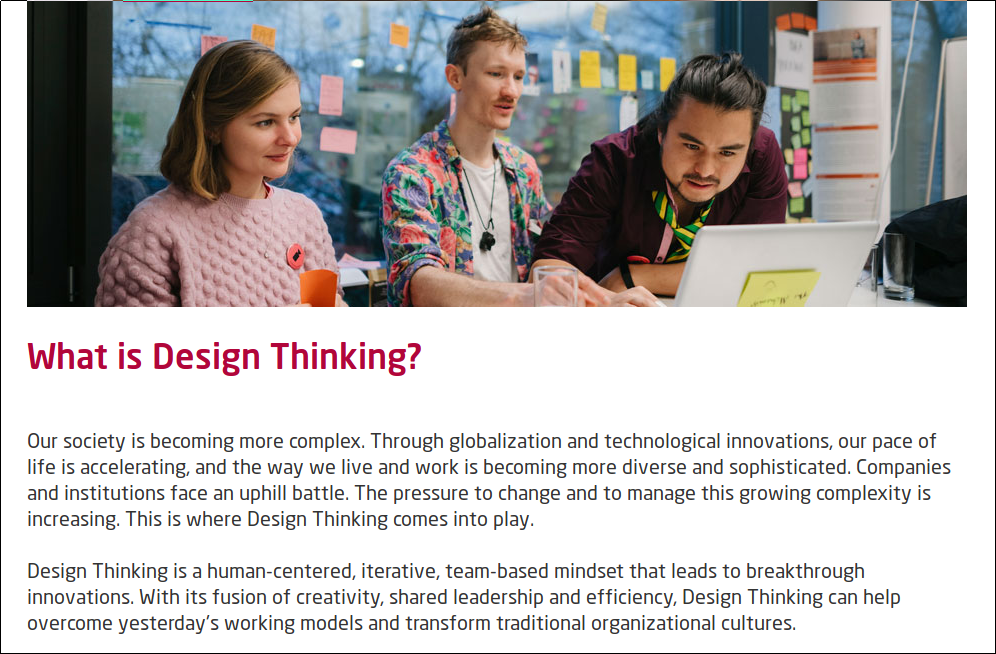
A screen Shot from the HPI website with its message of imminent doom and a handy, fun way out of all that pending disaster.
But design-thinking’s biggest takeaway is the holy grail of consulting itself - The Model. Management consultants have built their fortunes on building descriptive models that depict complex business situations in pithy, graphical charts.
All hail the Model
The most famous example is of course the BCG’s growth-share matrix, which it’s creator Bruce Hendersen explains, creates balanced portfolios.
“To be successful, a company should have a portfolio of products with different growth rates and different market shares. The portfolio composition is a function of the balance between cash flows…”
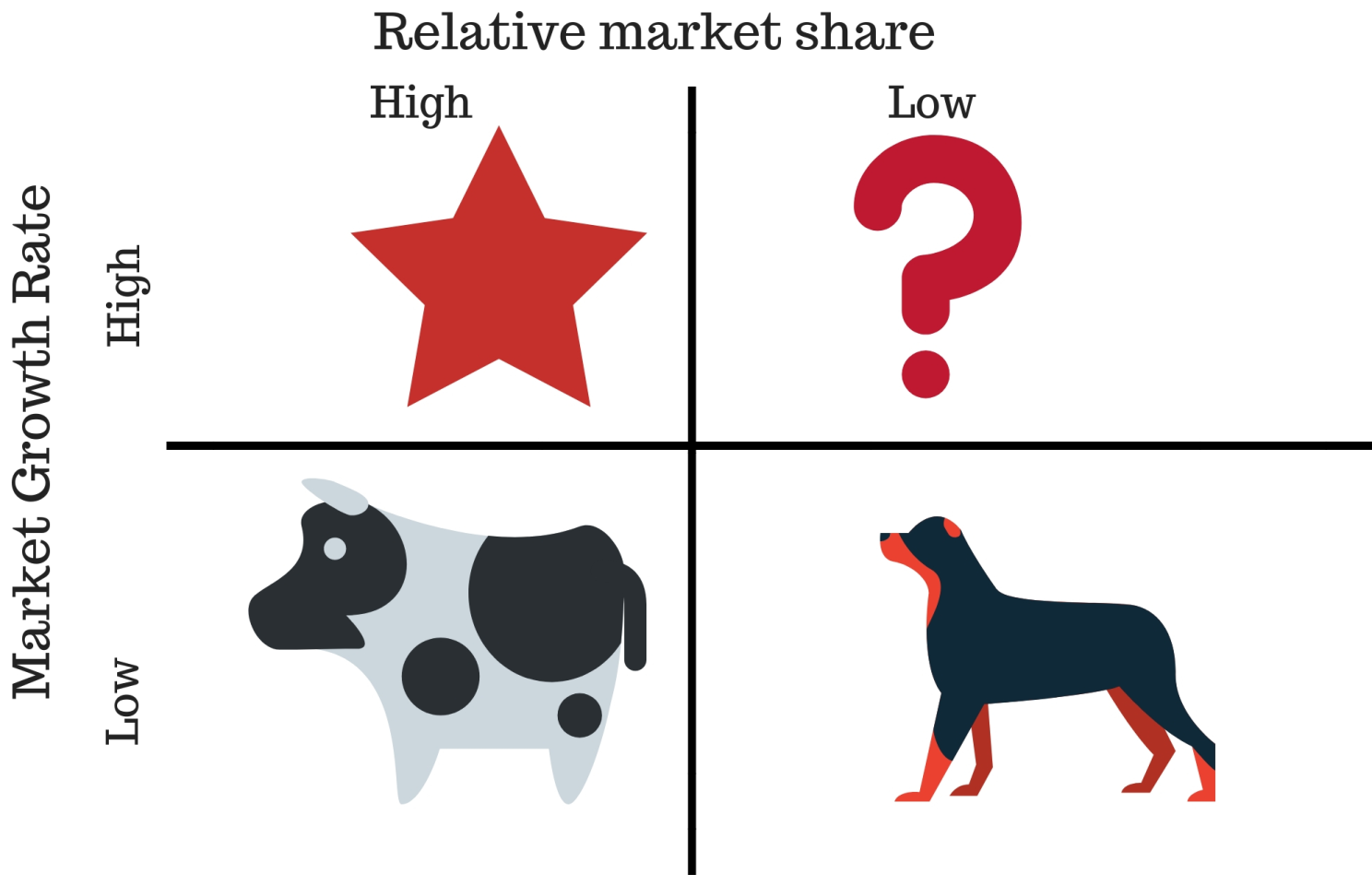
In ‘The Lords of Strategy’, Walter Kiechel narrates how some consultants called the matrix “the million dollar slide” for its ability to provide the client with a single, simplified snapshot of the organization’s strategic situation and what that could earn them. Never mind that the model assumes a deterministic view of the external environment, and an overly simplified view of internal structure and dynamics of the organisation., or that market research and analysis based on historic-data implies a certain path dependence. The consultants had correctly identified that restructuring the corporate portfolio was a real need and had evolved a model that helped clients discuss it. What happened here is significant. The consulting firm had turned an abstract idea into a concrete artefact, one that allowed people to share perspectives and discuss approaches.
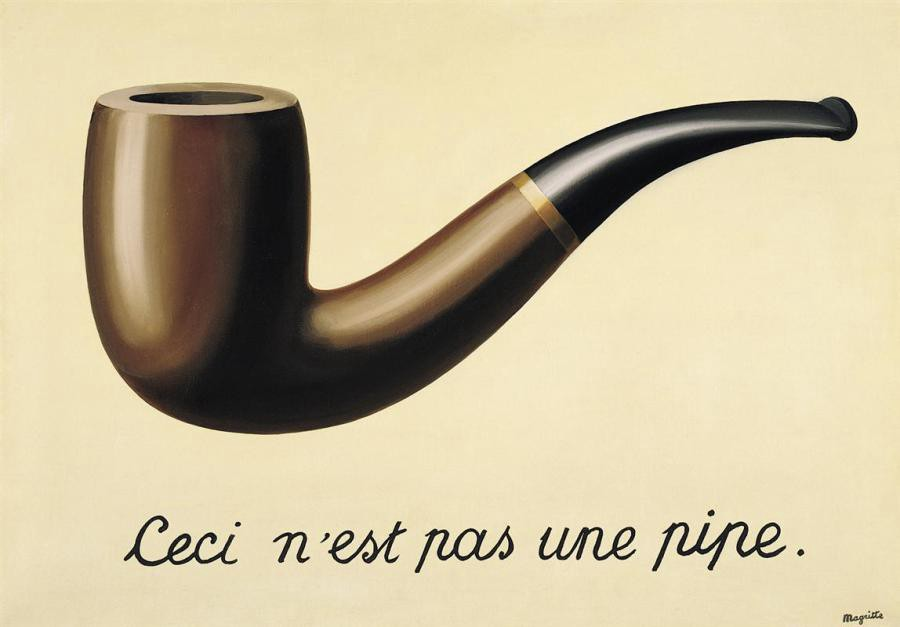
In his famous painting, The Treachery of Images, Magritte writes - This is not a pipe. He clarifies it’s paralanguage like this - “The famous pipe. How people reproached me for it! And yet, could you stuff my pipe? No, it’s just a representation, is it not? So if I had written on my picture “This is a pipe”, I’d have been lying! " — René Magritte
The primary use of models is to create shared perspective and facilitate communication. Logic Models for instance are wonderful for explaining the causal linkages that lead to an outcome, its the same reason that designers prototype models of their solutions. A model is something you can look at, analyse and discuss and build upon.
Think of models as conceptual lubricants to help push concepts and ideas into a differently configured mind.
The thing to remember about models though is that a model is not an actual representation of the system that it describes. Rather than point this out, consultants are more likely to enhance the illusion of reality in the model through the management version of paralanguage aka Business Bullshit. If it sounded better when the consultant explained it, its because consultants pay close attention to how ‘insights’ are evolved, worded, packaged and presented and because consultants understand that words model reality. Kiechel writes about how consulting firms paid close attention to specific words. Customers were to be called Clients for instance, because it provided better differentiation from accountants who called their customers - customers.

Design-thinking’s five step mnemonic describes its model in a perfectly reductionist way for businesses that are addicted to simplified models from management consulting. A google image search will show you how well this has worked out for design-thinking. It has come to be the single, most important thing driving it’s adoption, (also it’s most troublesome).
One final thing that design took away from Management Consulting was its guru culture. The idea of management consultants as business prophets, evangelists of hope in an uncertain and turbulent world, is one that design-thinking has learnt well. Design-thinking evangelists model themselves after people like Peter Drucker or Tom Peters, who have a cult like following in the business world. If earlier management theories were solutions to deal with the FUD of disruption, today it is all about how design-thinking can help you navigate a VUCA world and there are gurus who can help us.
Speaking of gurus brings us to the next major influence on design-thinking. It’s very soul, so to speak.
Where Design-Thinking got its woo-woo
If you smell the faint whiff of a cult forming around design-thinking, you’re not completely off. Design-thinkers are united in an ideological sense for sure, but its also something else. There is an ever-so-subtle flavour of spirituality in design-thinking’s vision of participatory human creativity in problem solving. Take a look at this description for a book by Dave Evans and Bill Burnett called Designing your Life, a new product from Stanford that lets you use design-thinking to design your own life.
BTW, no one seems to have picked up on the irony here. Something that is being marketed as a serious game changer for innovation at uber-large companies, also becomes a self-help tool. In a textbook case of confirmation bias, design-thinkers probably see this as further confirmation of how adaptive DT can be.
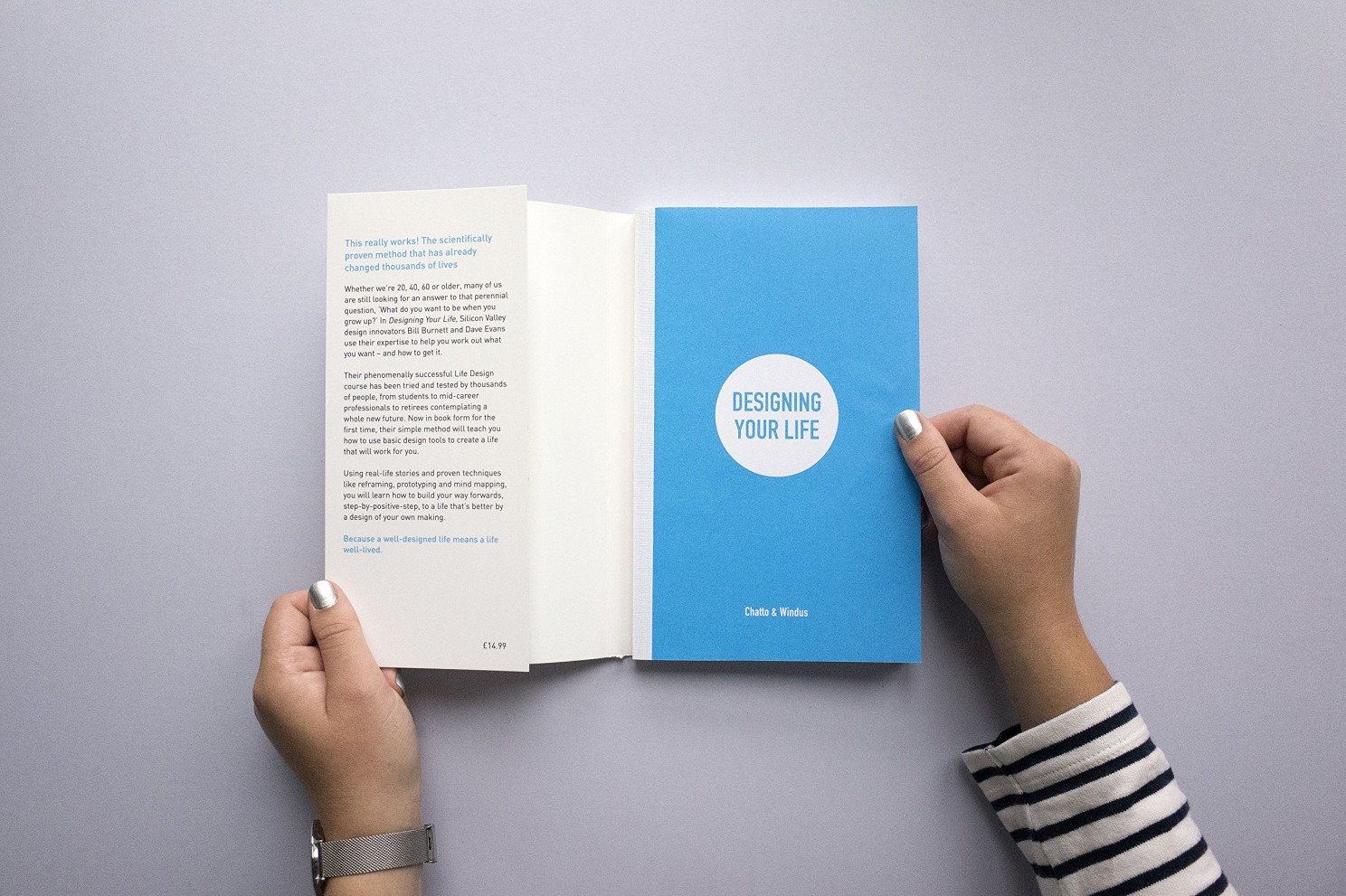
I didn’t read the book, just reviews of it, but I couldn’t help sharing this blurb from it’s website.
“In this book, Bill Burnett and Dave Evans show us how design thinking can help us create a life that is both meaningful and fulfilling, regardless of who or where we are, what we do or have done for a living, or how young or old we are. The same design thinking responsible for amazing technology, products, and spaces can be used to design and build your career and your life, a life of fulfilment and joy, constantly creative and productive, one that always holds the possibility of surprise.”
Meaning, fulfilment, joy, creativity, productivity - what does this self-actualizing language of endless faith in the human potential remind you of? and its not just that Dave Evans also holds a graduate diploma in Contemplative Spirituality. Design-thinking actually has far older roots in the new age spiritual tradition and ironically, some of those roots lead back to India.
The Self Actualisation of the Design Thinker
Self-actualisation in psychology evolved from a school of thought that stressed the need for a holistic, unified approach to human beings. Gestalt psychology, for instance, one of the schools that contributed to this set of ideas, was a reaction to more reductionist forms of psychology that tended to study parts instead of stepping back to look at the individual as a whole. (Remember designing for the whole-man from part One?) This new paradigm called for seeing human beings as a gestalt of their mindsets, predispositions, thoughts and actions, not as just a definition of the parts.

Self actualisation, which is right at the top of Abraham Maslow’s famous Hierarchy of Needs, is a part of Humanistic Psychology, a psychological theory that sees human beings as inherently good and filled with positive human potential. The theory which pays special attention to how people can reach their true potential by exercising their free-will and creativity has had such an impact and such sustained effects, that it persists today.
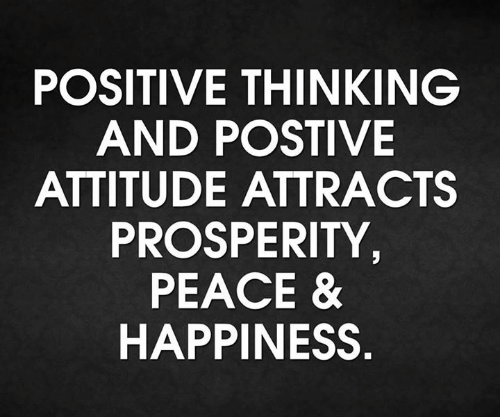
The next time you see a “Be Positive” or “Attract good vibrations” or “Be your true self” meme on Linkedin, you now know where these notions come from. The cult of positivity, that’s where. I’m not just being flippant here. Napolean Hill’s ‘Think and Grow Rich’ is available in the inventory of most street side book sellers in India, and its message of maintaining a positive mental attitude is so all pervading, that any criticisms expressed in social circles will be met with “Arre, don’t be so negative yaaar.” Meaning - Be positive.
I’ve seen design-thinking practitioners buying into this sort of positivity crap in serious business settings, labelling ‘positive’ and ’negative’ ideas as though it were any objective value system. When positive-thinking permeates your critical faculties, stories like the famous PlayPump incident happen. Unmitigated positivity leads to culturally and economically misplaced ideas.
I thought that design-thinking seems to be borrowing from Alfred Korzybski’s general semantics too, and I suppose this is to be expected. We can deduce from the current framing of design-thinking rhetoric that it was possibly influenced by theories from positive and humanistic psychology as well as from systems theory. Later, in its adolescent years it found meaning in the counter culture movement of the 60s alongside hippiedom and love and psychedelic drugs, through its association with the Esalen institute in California, founded by two Stanford grads. All of these coalesced into an expanded world-view of what self-actualisation could mean. Design-thinking actively grew out of the Human Potential Movement, which permeates the very soul of design-thinking today.
If you’ve read claims from design-thinking on how “anyone can learn to be creative and innovate in the face of the harshest problems facing society today”, you’re looking at a HPM inspired claim. Any criticisms about the inherent ability for someone to do either of those things, the need for years of dedicated practice and intellectual rigour is brushed away with one simple idea. Human Potential. The potential for anyone to be a design-thinker. Hume would fume and stick his fork into this sort of magical thinking, but objective reality has never gotten in the way of design-thinking’s march for innovation.
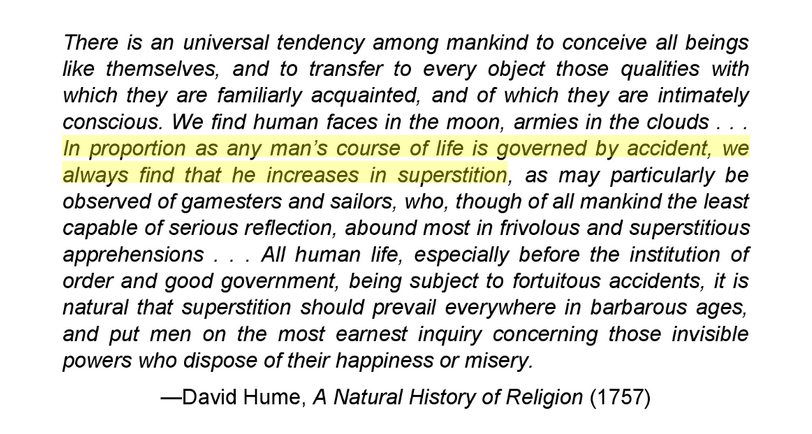
Even business superstitions need some TLC
Hume’s observation that superstition grows with ambiguity somewhat explains the role of management consulting in modern business. When you come across a phenomenon that is unexplainable, don’t panic. Just call in a consultant. Business superstition is a real thing, especially here in India, where it’s common for industrialists to visit god-men before incorporating a new business. I’ve asked several people over the years if such a thing as management science even exists and if it does, what makes it a science. I’ve never received a solid answer. Organisations that for years asked their design departments for quantified proof of future success in the quest for an objective, scientific approach to business decision-making, don’t seem to really worry about the entry of magic into their institutions.
I personally think that organisations have a superstition-sized hole that allows for more esoteric, magical minded concepts to enter their businesses. It’s called the HR department. The HR department is responsible for dealing with that thing we discussed a moment ago - The cussedness of human nature. Managing resources is one thing - managing humans is another thing altogether. To understand people’s behaviour and motivations is no mean task, and perhaps keeps scores of organisational psychologists up at night. Why do employees do the things they do and how can we get them to do the things we want them to do?
How HR departments cast a wide net
Since not every HR head can be expected to have a PHD in psychology and human behaviour, HR departments did the next best thing. They satisficed. They seem to have defined science fairly broadly and cast a wide net, so neurolinguistic programming, hypnosis, Law of attraction, Numerology, Myers-Briggs Type tests all enter the modern business in the ’need’ for organisational development. Design-thinking fits a similar sized hole in that net.
Of course gurus and magic go hand in hand, though the guru culture has slightly different cultural connotations in India as opposed to the west. In India gurus perform miracles, while in the west gurus are capable of a form of magick. Y’know, The Secret, The Laws of Attraction… that sort of thing.
Oooh, it’s a kind of magic
Alongside the counter culture movements of the 60s, there was also a new kind of spiritual belief system that was beginning to develop. The New Age movement draws on a number of esoteric occult traditions that developed in the past couple of centuries. If you’re from Chennai, you recognise the Theosophical society, one of the more prominent influences behind the movement. The world-view of those involved in the movement includes a wide range of belief systems - magical, occult, religious and cultural. Astral travel was considered quite normal with many travellers claiming the ability to travel in their sleep. Channelling spirits, angels and enlightened beings was also considered eminently doable by adepts. Alternative forms of medicine found a home in this open and welcoming belief system, including shamanic practices transplanted hundreds of miles from their original sources.
Dick Price, a graduate from Stanford travelled to India and visited the Aurobindo ashram and studied its philosophy. Price was also deeply interested in Buddhism and Taoism, and found a like-minded partner in Michael Murphy, also a Stanford grad. Together they purchased some land and started the non-profit Esalen Institute. The institute was formed as a space where people could explore counter cultural workshops and experience the philosophy and culture of the new age movement.
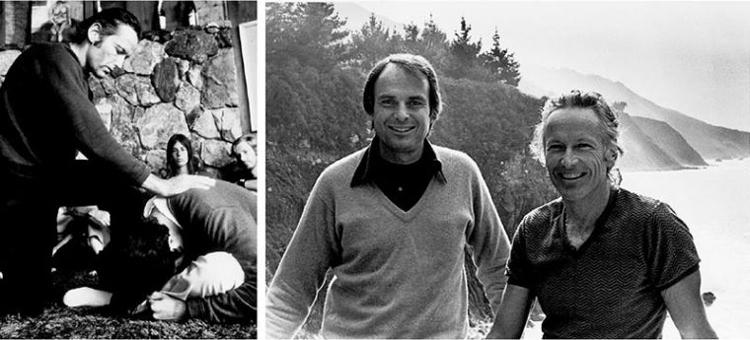
The Esalen Institute hosted a wide range of speakers. Aldous Huxley spoke there, and he was one of it’s inspirations. So did Alan Watts, Carlos castaneda, R.D Laing, Fritjof Capra and Gregory Bateson. I consider many of those who spoke there as geniuses who had more than the reductionist, traditional viewpoints their colleagues did, and importantly - spoke publicly about it. This wide ranging mix of magic and science, spirit and matter, mind and body - dichotomies that the more career minded would not touch with a barge pole, became a fertile source of inspiration for those around it. It influenced many at Stanford and It influenced IDEO too, and so many years later, it’s still the place for the rich and famous of silicon valley to gain perspective and maybe confess their sins into the warmth of its ever loving embrace.
Deconstructing Design-thinking today
The rhetoric on design-thinking today uses language that can be traced back to many of the movements and schools of thought we have discussed so far. When design-thinking practitioners describe a room as filled with ‘positive energy’, ‘good vibes’ and the promise of the human potential for change, you can understand where these notions come from. (Sometimes design thinking tends to go overboard with the use of such language, to the point of incomprehensibility.)
So here we are. Having explored DT’s influences, we can understand where some of its assumptions, mindsets and the symbolism come from. How it’s highly positive and optimistic tone comes from its influences in humanistic psychology and new age spirituality. How colourful post-it notes, become a representation of a designer’s desk, littered with sketches, ideas and approaches, resembling the creative clutter of a designer, without the depth needed to produce it. How the notion that the cognitive diversity in participatory design, is best leveraged by generating a larger quantity of ideas, rather than narrowing the range for higher quality exploration.
There are many kinds of design-thinking today. The worst kind is a little of everything that influenced it and not very substantial in itself.
Still, for all the inanity and bloviating of generic design-thinking and it’s promoters, DT is turning out to be useful in an interesting, round about way. Its emphasis on human-centered design is waking organisations up to the importance of human cognition and the need for critical thinking by human beings. Today machines are far more capable of analytical procedures than people are, and as we move more and more tasks over to be automated, we become more aware of the types of tasks that machines cannot do as well - via negativa.
As more people explore design-thinking, perhaps it will spark in them a genuine desire to seek out its heart - design, and perhaps that journey will culminate in what Arnold called comprehensive design, all those years ago.

Up Next
In the next part of this series, I explore the claim that anyone can innovate using the DT method. You can read part three here.