Drawing away from Mindlessness
There is a group in Bangalore that gathers on Sundays to draw. They fill their sketchbooks with subjects that most people wouldn’t consider worthy of attention—landscapes, buildings, trees, vehicles, animals and people going about their daily lives.
Sometimes a passerby notices them at work, and asks, “what will you do with these drawings?” The assumption is that the drawings must be important—an object of value. Surely, if drawing takes hours of work, such labour must attract a price.
They are partially right. These artists are definitely generating something of value, but you won’t find it in their sketchbooks.
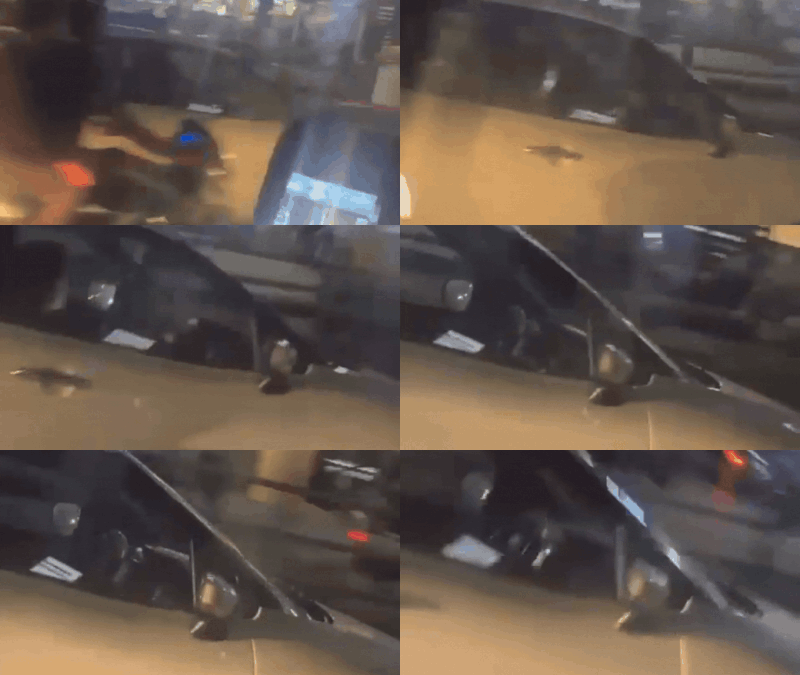
A motorist shot a video, earlier this year, of what people are increasingly referring to as a Peak Bangalore moment1. It shows a woman driving through rush hour traffic, and at the same time, also working on her laptop. The traffic police fined her the next day.
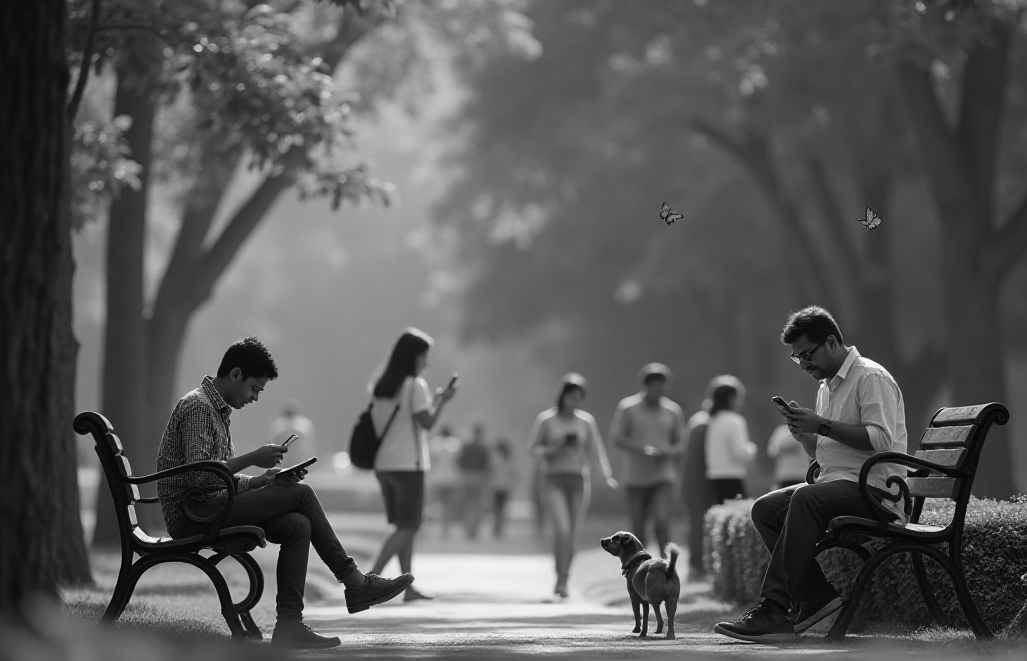
This is a common sight for those who live in the city, and it’s not all about work. Stand along a roadside, and observe the number of people who walk by with their heads buried in their smartphones. This is now a worldwide affliction, as the animator Steve Cutts depicts so well in his animation for the music video for Moby and the Void Pacific Choir.

One would think the solution to this is simple, people should stop using these devices until there is an actual need and let their minds reset to drinking in the world around them.
It doesn’t work. A smartphone is an escape from what a lot of people consider the mundane horror of daily life. In 2022, a 15-year school boy in Tripura, killed his mother, sister, grandfather and a neighbour in a fit of rage because his mother denied him the use of her smartphone. Just this month, an 11-year-old girl in Rajkot committed suicide. Investigators believe it is because her elder sister denied her the use of a smartphone. Delaying gratification is hard for children, but the insidious design of dark-patterns in smartphone apps seem to make it hard for adults as well.
Why is the real world so boring to so many people that they would rather just fall into an abyss of mindlessness that smartphones offer?
There is an interesting exercise I conduct during my workshops2 for the corporate world. I tell participants to draw a tree and also tell them this is not a test of drawing skill. Five minutes later, people show me what they have drawn, and it is almost always something that looks like a little cloud on a stick.
A few minutes later, I ask them to do it again, except this time, I tell them to first picture a tree they are familiar with. Perhaps one that grows outside their home, or by the roadside, on the way to work. They take longer to draw this one, and it is inevitably more detailed. Sometimes you can even recognise the type of tree they have drawn. What changed? Did they somehow become better artists the second time they drew?
Ellen Langer3, a social psychologist and the first tenured female professor in the psychology department at Harvard University has been studying mindless behaviour since the 1970s. “Most of the ills that people experience as individuals, in their relationships, in groups, in cultures,” she says, “virtually all the ills, are a result of mindlessness.”
Mindlessness, she says, blinds us to new possibilities, which is what led her to study it’s twin—mindfulness. And what is mindfulness?
Mindfulness, according to Langer, is to be aware. To actively notice new things, without preconceived ideas, and then to act on these new observations.
When the participants in my workshops draw trees that look like a cloud-on-a-stick, they are recalling a symbol. Symbols are easy. They consume less cognitive resources, and are an important survival mechanism. Reducing the world to symbols lets us react to potential threats faster, but then, they also cause a state of mindlessness. We think we know what a tree is, and we stop paying attention to it.
When I ask my workshop participants to spend a few seconds visualising a specific tree, they start to see the tree with fresh eyes. Perhaps they see it outside their bedroom window, sunlight streaming through its leaves, or maybe the only summon a vague picture of a tree they know is beside the bus-stand they visit every morning. Even these basic visualisations make a difference in the drawings they create. There is a vitality to these drawings, a visible freshness.
That simple act of visualising a tree—even for just a minute— makes them mindful of it
The artists I wrote about at the beginning of this post are a group called Penciljam4. Smitha Shivaswamy and I, founded Penciljam in February of 2009, to encourage this sort of mindfulness through drawing. We promote the Citizen Arts, an idea proximal to Citizen Science or Citizen Journalism, in that, it encourages a social model for the Arts. It invites people from all walks of life to participate in group drawing, not as a way to create great art, but to be aware of the world around us.
Over the 15 years since we started Penciljam, our community members have told us how much this simple act of turning up week after week to draw with others, has affected their lives.
“When there is no pressure to display your work to someone, and you sit and draw just for the pleasure of it will unlock a new window in the mind, and heart that flows through my hand,” wrote a lady who works in a high-pressure startup environment, describing what it is like to draw at these weekly gatherings.
Penciljam’s drawing sessions don’t just help people reflect on how drawing makes them feel, it also helps them belong to a community. The drawing sessions are free (as in free speech, as well as in free beer), with very few rules about what one actually does during these sessions. I personally believe that this mix of autonomy and connectedness is what has contributed to the longevity of this community.
“While forming social bonds with others satisfies the need for connection, it can also constrain a person’s choices by requiring them to consider the consequences of their actions for others. If those constraints are strict, they threaten autonomy. In contrast, prioritising one’s own goals and preferences without any regard for the needs and desires of others would maximise autonomy, but make one unpalatable as a relationship partner or group member.”
William von Hippel, Evolutionary Social Psychologist, in an article on Psyche
In India, the perception of art is that it is either a luxury, or a children’s activity, meanng, it is for those who have excessive time at their disposal. Artists are often asked what they really do for a living, the implication being that responsible adults find real jobs.
Even when people do take up the arts, it is with the goal of becoming a ‘bona fide artist’. Someone who exhibits their work in galleries, with elevator music streaming in the background, wine and cheese in hand. People who create art for its own sake are rare. While it is wonderful to see an amateur transform into a professional, the actual purpose of our community is to promote the idea of drawing as an act of self discovery.
In Biology class at school, teachers use the analogy of the camera to teach us how our eyes work. As we grow up, we accumulate other such reductionist ideas until we eventually forget that we are more than the machine-like functioning of our parts. We reduce output to input, the hours of the day to a to-do list.
Here is a quote from one of my favourite authors, Terence James Stannus Gray, who goes by the pseudonym Wei-Wu-Wei5.
“Are we not wasps who spend all day in a fruitless attempt to traverse a window-pane – while the other half of the window is wide open?”
When we draw, the separation between us and what we observe falls away. Eventually, we begin to pay attention to things we dismiss as mundane. When I observe a tree long enough to understand the precise ways in which its limbs curl, and translate this into form in my sketchbook, I come to understand that specific tree, and in the process, I come to understand myself.
The tree is no longer a symbol, and I am, for a few hours, no longer mindless.
Notes
The featured image is AI generated, though you can find a lot of examples of ‘peak Bangalore’ memes online, such as this Reddit Post. ↩︎
These workshops are conducted through my consulting firm, Ideasutra._ I’ve written a piece on the tools I use to design these workshops here. ↩︎
For more on Ellen Langer, this article from Harvard Magazine. ↩︎
Penciljam is free and op_en to everyone. Visit the website here. ↩︎
I drew this comic strip inspired by Wei-Wu-Wei, and wrote this story about the stories we tell ourselves. I also wrote a piece on the Illusion of Self, based loosely around the practice of User Experience Design. ↩︎